Last Updated: June 7, 2026 | By the E3 Aviation Editorial Team
The airspeed needle pegs at the high end of the white arc on takeoff roll. Then it keeps climbing past VNE while you’re barely off the ground. Or the altimeter freezes at the field elevation while the VSI sits dead at zero. Pitot-static system failures show up like this. Quiet, weird, easy to mistake for a real performance problem. And they kill GA pilots every year because the cues feel like something else.
This guide breaks down pitot-static system failures the way you actually meet them in a piston single. We’ll cover what the system really does. We’ll cover how a pitot block differs from a static block. We’ll cover the cockpit signatures that give each one away. We’ll cover the 24-month inspection rule. And we’ll close with the personal-minimums habits that keep a quiet failure from becoming an accident chain.
You don’t have to memorize every gauge-error formula. You do have to recognize the pattern fast enough to fly the airplane while your instruments lie to you.
What the Pitot-Static System Actually Does — and Why Pitot-Static System Failures Bite GA Pilots
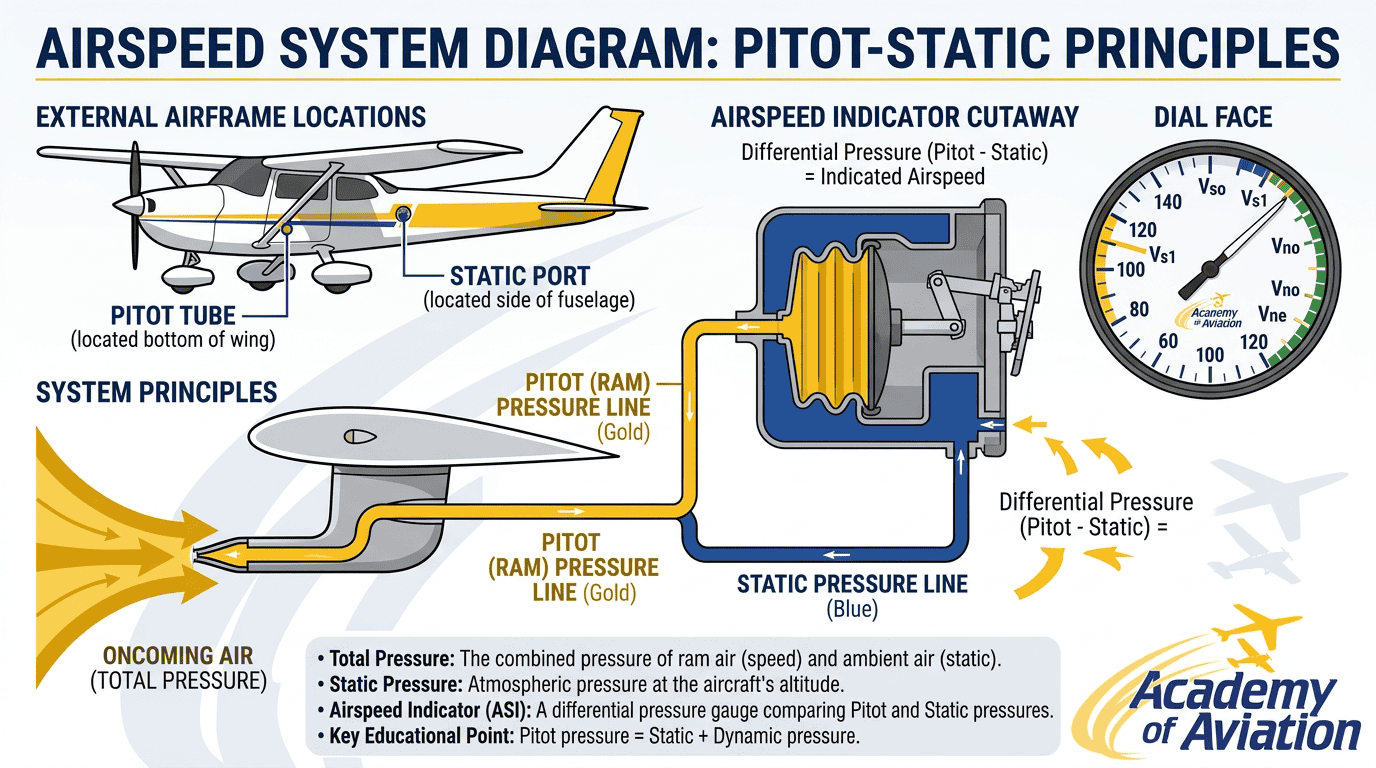
The pitot-static system is two pressure circuits feeding three instruments. The pitot tube samples ram air pressure — the force of the air the airplane is flying through. The static ports sample ambient air pressure — the still air around the airframe. The airspeed indicator subtracts static from ram and shows you the difference. The altimeter and vertical speed indicator read static only. FAA PHAK Chapter 8 lays this out in detail.
Pitot-static system failures bite GA pilots because the instruments don’t go blank. They keep showing numbers. Wrong numbers, but plausible ones. A blocked pitot tube can make the airspeed indicator climb in cruise and crash on descent. A blocked static port can lock the altimeter and freeze the VSI. Neither failure throws a flag. You have to spot it from the pattern.
Cluster 8 in our system is aircraft systems. Pitot-static system failures sit at the top of the cluster. They tie into airspeed, altitude, climb rate, and the autopilot’s pitch logic all at once. Get the cues right and you fly through the failure. Miss them and you chase the gauge into a stall or a descent.
The Three Instruments at Risk When Pitot-Static System Failures Happen
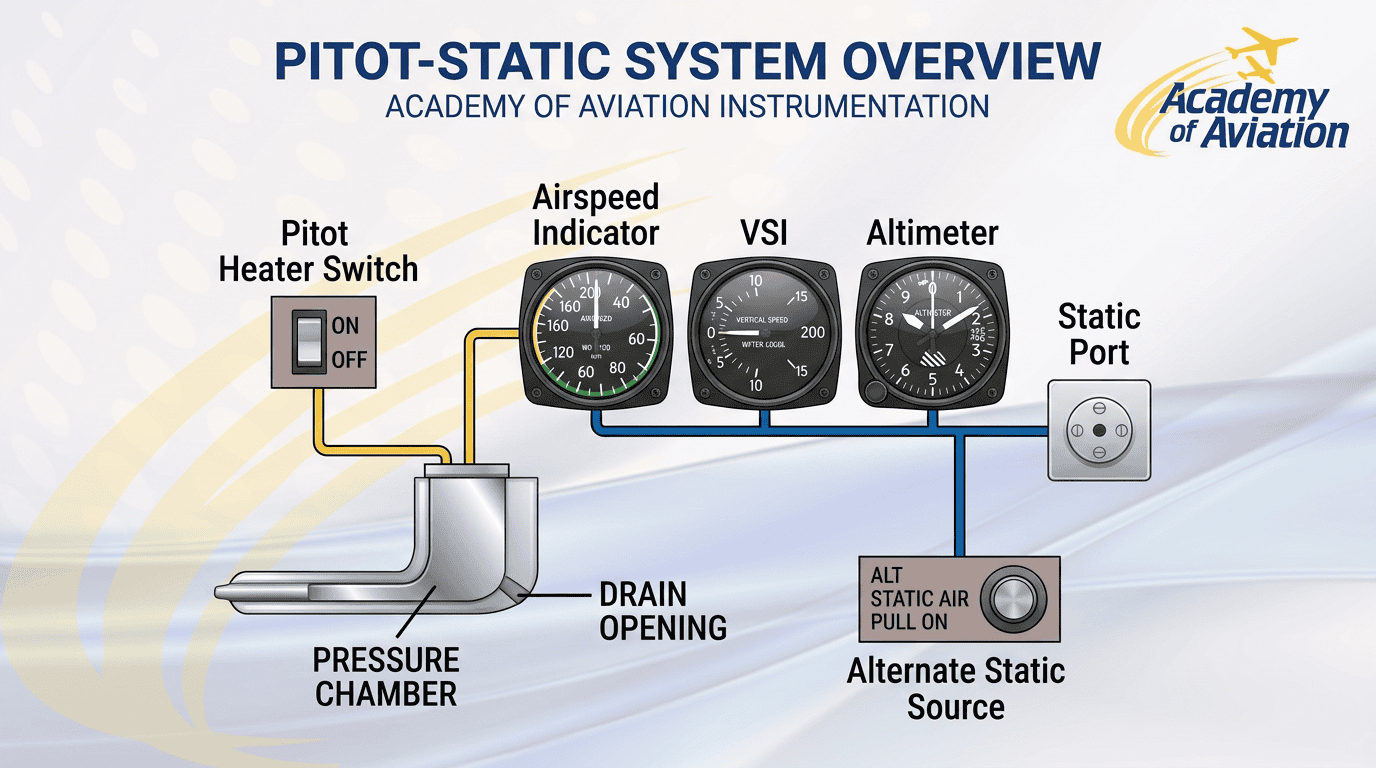
Three gauges share the pitot-static plumbing. Each one fails differently. Knowing which gauge does what when the system goes bad is half the battle.
Airspeed indicator behavior
The airspeed indicator is the one most exposed to pitot-static system failures. It needs both ram and static pressure to work. Lose the pitot side and the ASI behaves like an altimeter. It rises in a climb and falls in a descent. Lose the static side and the ASI reads low in a climb and high in a descent. The directions matter. Memorize them.
Altimeter behavior
The altimeter only reads static pressure. A clean pitot block does nothing to it. A static block freezes it at the altitude where the port plugged. The needle won’t move even if you climb 2,000 feet. That’s the loudest signature of a static failure and the one most pilots catch first.
Vertical speed indicator behavior
The VSI is a static-only instrument with a calibrated leak. Lose static and the VSI freezes at zero. It might twitch with cabin pressure changes, but it won’t show climb or descent. That’s another classic static-failure cue and one that lines up cleanly with a stuck altimeter.
Blocked Pitot Tube vs Blocked Static Port — The Cockpit Difference
Two pitot-static system failure paths. Different cockpit pictures. The difference is the diagnostic you make in seconds, not minutes.
A blocked pitot tube with the drain hole also blocked turns the airspeed indicator into a crude altimeter. Climb 1,000 feet and the ASI shows a fast climb in indicated airspeed. Descend and the ASI shows a fast slowdown. Altimeter and VSI keep working. That mismatch is the cue. The ASI is doing something the altimeter and VSI aren’t.
A blocked static port hits all three instruments at once. Altimeter freezes. VSI drops to zero. ASI reads low in climbs and high in descents. The needles disagree with what the airplane is doing — and they agree with each other in their disagreement. Three quiet gauges all locked together is the static-block cue.
Some pitot tubes have a drain hole that handles light blockage. If the drain hole is clear and the front opening is blocked, static pressure equalizes through the drain. The ASI then drops to zero or reads way low. That’s a third pattern worth memorizing — ASI dead while altimeter and VSI work normally.
How Pitot-Static System Failures Show Up at Cruise Versus Climb and Descent
Pitot-static system failures look different depending on what the airplane is doing. The same blockage shows you different lies at different parts of the flight.
At a steady cruise altitude the cues are subtle. A pitot block won’t move the ASI much because the airplane isn’t changing altitude. The needle holds station. You might cross-check groundspeed on the GPS. The indicated airspeed and the groundspeed don’t agree the way they should with the wind. That’s often the first cue at cruise.
In a climb a pitot block sends the ASI up. The airplane is climbing into thinner static air. With the pitot side stuck, the static side of the ASI capsule drops and the gauge reads faster. Pilots who don’t expect this can chase the needle into a stall thinking they’re getting away. The airspeed reads fine, but the airplane is slowing down behind it.
In a descent a pitot block does the opposite. The ASI plunges. The natural reaction is to lower the nose and push for more airspeed. The actual airspeed climbs above VNE while the gauge tells you you’re slow. Loss of control on descent is the worst-case outcome.

The Cold-Air and Icing Pathways Behind Pitot-Static System Failures
Cold air is the leading in-flight trigger for pitot-static system failures in piston singles. The pitot tube and the static ports both run external to the airframe. They ice up the same way the leading edge ices up. The difference is you can’t see them.
Most certified GA aircraft have a pitot heat switch wired to a heating element inside the pitot tube. The element keeps the tube above the freezing point in visible moisture. If the bulb burns out, the breaker pops, or the pilot forgets to turn it on, the tube ices over. It freezes the same way a wing leading edge does. Our structural icing in piston singles guide covers the airframe side.
Static ports rarely have heat. They depend on freezing-level avoidance and on the alternate static source switch in the cockpit. Flying a non-FIKI piston single through freezing rain or freezing drizzle is the textbook way to lose both at once. You get two pitot-static system failures. They stack on a structural icing problem. And on a horizon you probably can’t see.
The Bug, the Cover, and the Hangar Floor — Pre-Flight Causes Pilots Underestimate
Bugs are the silent cause of pitot-static system failures in summer. A mud-dauber wasp can build a nest inside an uncovered pitot tube in a single afternoon. Birgenair 301 in 1996 lost a Boeing 757 the same way. A suspected wasp nest in an uncovered pitot caused the captain’s ASI to read high. The copilot’s ASI read low. The crew chased the wrong gauge into the Atlantic.
The fix is cheap and is the first thing on a sound pre-flight habit list. Pitot covers go on every time the airplane parks outside. Static port covers if you have them. A walk-around look at the pitot opening with a flashlight, not just a glance. Bugs build during the day. The morning pre-flight catches what the evening tie-down missed.
The hangar floor is the other underrated source. Drop the pitot cover on a dusty floor. Put it back on the tube without cleaning. You’ve turned a protective measure into a contamination vector. Our aircraft storage guide covers the cover-and-cap discipline that keeps systems clean during long parking.
14 CFR 91.411 and the Static Check You Cannot Skip for IFR
Pitot-static system failures aren’t just a flying-skill problem. They’re a regulatory one. 14 CFR 91.411 sets the rule. Every aircraft flown in controlled airspace under IFR needs three items inspected on a 24-calendar-month clock. The static system, the altimeter, and the altitude reporting equipment.
The test method comes from 14 CFR Part 43 Appendix E. A certified shop pulls a vacuum on the static side. It watches for leaks. It runs the altimeter through its calibration points. And it verifies the encoder matches what ATC sees. FAA Advisory Circular 43-6D spells out the acceptable methods.
The 24-month rule is for IFR. VFR-only operations don’t require it. But here’s what most pilots get wrong. A static system that hasn’t been pressure-tested in five years probably has slow leaks. You’ll never feel them on a VFR day with the cabin sealed. The leak shows up the day you fly into a deck of clouds. The altimeter then starts arguing with ATC. IFR currency requirements cover the legal floor. Part 43 covers the airplane’s contribution.
The Alternate Static Source Pilots Forget Until It Matters
Most GA aircraft equipped for IFR have an alternate static source. It’s a small valve in the cockpit. It lets the altimeter, VSI, and ASI sample cabin air when the external static ports are blocked. Pull the knob and the system breathes from inside the cockpit. That’s the procedural answer to a static-port blockage — one of the most common pitot-static system failures in flight.
It’s not free. The PHAK warns that the alternate static source reads slightly different from the external static ports. The ASI usually shows a higher indicated airspeed than the real one when on alternate static. The altimeter usually reads slightly higher. The POH gives the correction values for your specific airframe. Look them up before you need them, not during the failure.
In an airplane without an alternate static source, the emergency method is breaking the face of the VSI. The VSI then vents to cabin static pressure and feeds the rest of the system. It’s destructive but it works. Don’t do it unless you’ve ruled out everything else and the static block is forcing you down.
Cold Temperature Altimeter Errors That Mimic Pitot-Static System Failures
Cold-air errors aren’t pitot-static system failures, but they look like them. AIM Chapter 7 Section 3 covers cold-temperature barometric altimeter errors. The short version: a standard altimeter reads true altitude only at the temperature it was calibrated for. In very cold air, the altimeter reads higher than your actual altitude. You think you’re at 5,000 feet MSL. You’re really at 4,700.
The FAA designates Cold Temperature Airports (CTAs) where the error gets bad enough to matter on approach. The AIM has the correction tables. Pilots who fly winter operations in Montana or Alaska have these in muscle memory. Pilots based in Phoenix don’t, and the first cold-weather trip is where the cue gets missed.
Our density altitude guide covers the opposite case — hot, thin air on takeoff. Cold-temp altimeter error is the same physics running the other way. Treat it like a known instrument error, not a system failure.
Five Pre-Flight Habits That Catch Pitot-Static System Failures Before Takeoff
The cheapest place to catch pitot-static system failures is on the ground. Five habits, done every flight, take less than two minutes:
- Visually inspect the pitot opening with a flashlight. Not a glance from six feet. A close look down the tube. Bugs, dirt, ice — anything that doesn’t belong.
- Check static ports for obstruction. Both sides on most singles. Tape, polish residue, ice, paint chips. The static port is small and easy to miss.
- Pitot heat function test before runup. Switch on for 10 seconds with the pitot tube clear of skin contact. Verify ammeter or load meter shows the draw. Switch off. The heater is worthless if you don’t know it works.
- Confirm pitot cover removal. Walk-around items get missed when the pilot rushes. A flag-style cover with a “REMOVE BEFORE FLIGHT” streamer reduces the miss rate.
- Cross-check field elevation on the altimeter. Set local altimeter. Compare to known field elevation. A delta over 75 feet is a yellow flag worth a deeper look before takeoff.
None of these habits require a mechanic. Every one of them has caught a pitot-static system failure for somebody in the past 12 months.
Five Cockpit Habits That Save You When Pitot-Static System Failures Happen Aloft
If a pitot-static failure shows up after takeoff, the airplane is still flying. The instruments are lying, but the wing isn’t. Five cockpit habits buy back control:
- Fly attitude and power. Pitch the nose to a known attitude and set a known power setting. The airplane that flew before still flies on those numbers. The V-speeds reference matters because attitude + power = a roughly known airspeed.
- Cross-check GPS groundspeed. Indicated airspeed isn’t groundspeed. But a steady GPS groundspeed at a known wind tells you the truth. The airplane isn’t decelerating into a stall while the ASI reads fast.
- Pull the alternate static source — if the failure looks static. Three frozen needles together is the cue. Pull the knob, re-trim, and apply the POH correction values.
- Turn off the autopilot. Modern autopilots pitch to hold an indicated airspeed. A bad ASI commands a bad pitch input. Hand-fly the airplane.
- Declare and land. Pitot-static system failures are an emergency in IMC and a serious abnormal in VMC. ATC can give you radar altitude calls and a no-gyro descent. Use them.
The habit list isn’t a checklist replacement. Every airframe has its own emergency procedures section. Read it before takeoff, not after the gauge starts arguing with you.
Personal Minimums for Flying After a Recent Pitot-Static System Failure or Inspection Lapse
An airframe that just had a pitot-static finding deserves a softer return-to-service profile. Pilots who race back to IFR cross-country flights after a static repair sometimes find a second leak. The technician didn’t catch it the first time.
A starter personal-minimums frame after a pitot-static event or 91.411 lapse looks like this.
- First flight VMC day, ceiling 3,000 feet AGL or better, visibility 5 SM or better.
- Local pattern work or short cross-country only — 50 NM out and back.
- Hand-fly the airplane. Autopilot off for the entire flight.
- Cross-check ASI versus GPS groundspeed every 10 minutes. Log it.
- No IFR for at least two flights, even if the logbook says signed off.
Pilots who fly with a sound aircraft panel scan habit catch the second leak in the first 20 minutes. Pilots who don’t catch it later, when the conditions are worse. Our instrument proficiency check walkthrough is also worth a refresh before the first IFR flight after a static repair.
Our Take on Pitot-Static System Failures in 2026
We’ll be straight with you: pitot-static system failures are a recognition problem more than a maintenance problem. The plumbing is simple. The instruments are old technology. What kills pilots is the moment of doubt. The three seconds where the ASI says one thing and the airplane does another. And the pilot trusts the gauge over the feel.
Honestly, this is where we’d push back on the “modern glass panel solves it” claim. A G1000 cross-checks airspeed, altitude, and GPS. But the underlying pitot and static lines are the same as a 1975 Cessna 172. The block at the front end gives the glass the same lie it gives the round dial. The fix is the pilot, not the avionics.
If you haven’t run a pitot heat function check this month, do it before the next flight. If your 91.411 sticker is more than 20 months old, schedule the shop visit now. And practice partial-panel work on the next dual flight. Pitot-static system failures are the failure mode you can train for cheaply. And the one that catches the pilots who didn’t.
FAQ: Pitot-Static System Failures
What’s the single most common cause of pitot-static system failures in GA singles?
External pitot blockage from bugs, ice, or a forgotten pitot cover. Internal failures of the airspeed indicator, altimeter, or VSI are rare in well-maintained airframes. The plumbing and the openings outside the airframe are where the failures concentrate. A pitot cover with a flag-style streamer plus a flashlight check on the tube opening removes most of the risk.
Do I need a 91.411 static check if I only fly VFR?
Legally no. 91.411 applies to IFR operations in controlled airspace. Practically yes. A static system that hasn’t been pressure-tested in five years usually has slow leaks. The leak shows up the day a VFR-only pilot inadvertently enters IMC or files a pop-up IFR clearance. The 24-month inspection is cheap insurance.
What’s the single best habit to defend against pitot-static system failures?
Cross-check indicated airspeed against GPS groundspeed every 10 minutes in cruise. A bad pitot or a bad static will reveal itself as a mismatch you can’t explain with wind. Pilots who run this cross-check catch failures early. Pilots who don’t catch them late, when the airplane is descending into worse conditions.
Further Reading
- Stall Recognition and Recovery: A GA Pilot’s 2026 Guide
- Secrets of the Effortless Aircraft Panel Scan for Pilots
- Instrument Proficiency Check: What It Covers and How to Pass
- IFR Currency Requirements 2026: Stay Legal and Ready
- Loss of Control Prevention: The 3 GA Traffic Pattern Killers
- Aviation Emergency Mindset: Staying Calm Under Pressure
- Structural Icing in Piston Singles: A 2026 GA Pilot Guide
- Density Altitude: The Complete GA Pilot Guide for 2026
- Aircraft V-Speeds: Every GA Pilot’s Quick Reference
- Angle of Attack Indicators for GA Safety
- Spatial Disorientation in GA Crashes: Prevention Guide
- Human Error in GA Accidents: What Pilots Can Actually Do
- GA Fatal Accident Rate 2026: Why the Numbers Keep Falling
- Aircraft Storage Guide
- Aircraft Weight and Balance: The Complete GA Pilot’s Guide for 2026
External Authority References
- FAA Pilot’s Handbook of Aeronautical Knowledge — Chapter 8 Flight Instruments
- 14 CFR 91.411 — Altimeter system and altitude reporting equipment tests and inspections
- 14 CFR Part 43 Appendix E — Altimeter System Test and Inspection
- FAA Advisory Circular 43-6D — Altitude Reporting Equipment and Transponder System Maintenance
- FAA AIM Chapter 7 Section 3 — Cold Temperature Barometric Altimeter Errors