Last Updated: July 9, 2026 | By The E3 Aviation Editorial Team
Every general aviation pilot eventually gets the same wake-up call. Your panel comm goes silent on a Sunday afternoon. Ground stops answering. The tower’s next call fills the cabin with static. That’s when a handheld earns its keep. The best handheld aviation radios sit quietly in the flight bag until the day they save the flight. AirVenture 2026 opens in less than two weeks. This is a great time to think about which one belongs in yours.
We’ll be straight with you. Most GA pilots carry the wrong radio, carry the right radio with dead batteries, or don’t carry one at all. This 2026 buyer’s guide fixes that. We’ll compare the four handhelds that dominate GA flight bags right now. Then we’ll break down the specs that matter. Finally, we’ll show you which radio fits which mission.
Why Every GA Pilot Should Carry One of the Best Handheld Aviation Radios
A panel radio failure isn’t a rare event. It happens often enough that the FAA published AIM 6-4 to cover it. Squawk 7600, keep flying VFR when able, and land as soon as practicable. That’s the rule. But nothing in AIM 6-4 tells you how to actually call the tower when your primary comm dies on downwind.
That’s where the best handheld aviation radios come in. A backup transceiver in your flight bag turns a NORDO emergency into a nuisance. You unplug your headset from the panel, plug it into the handheld, and finish the flight normally.
Beyond total failure, handhelds handle other real problems too. Ground start requests before engine start. Ramp coordination without draining the ship’s battery. Traffic monitoring from a fly-in campsite. Backup comm during preflight at a busy field. If you’ve flown into AirVenture, you know what a handheld earns during the Fisk arrival.
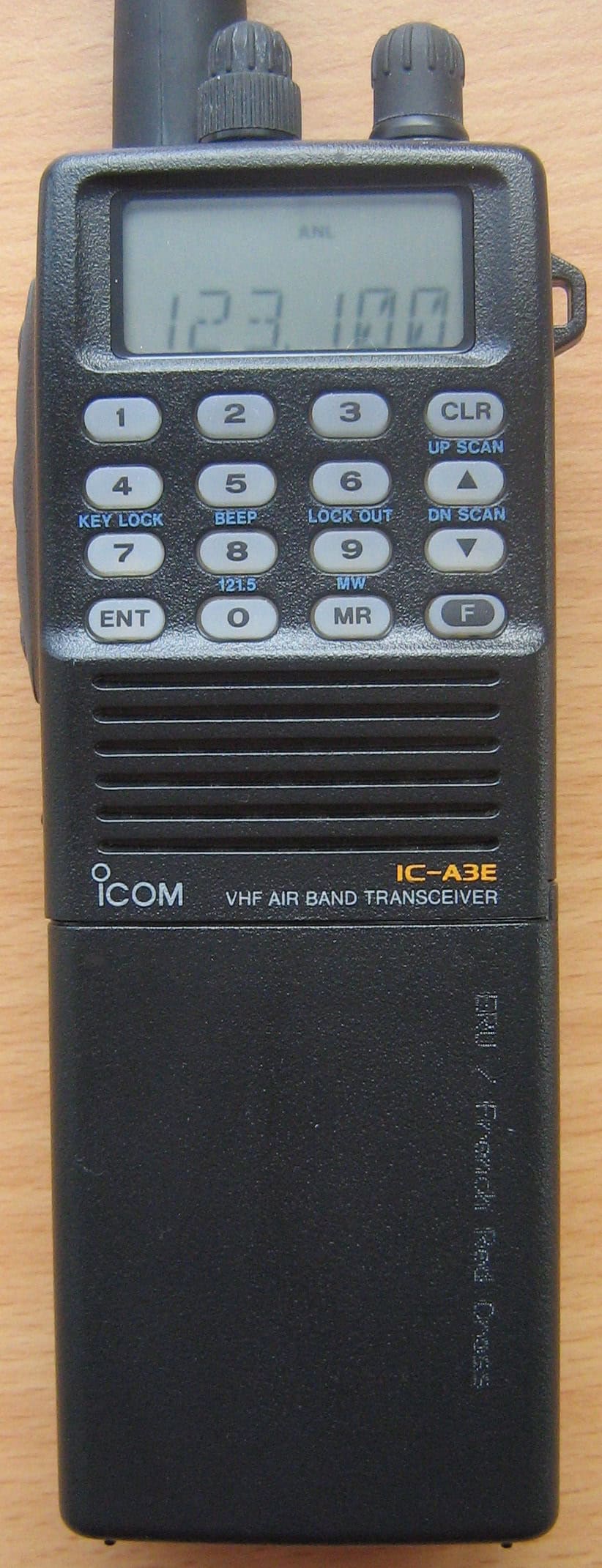
What the Best Handheld Aviation Radios Actually Do in the Cockpit
Modern handheld aviation transceivers do four things. First, they transmit and receive on the aircraft VHF comm band, 118.000 to 136.975 MHz. Second, most now cover 8.33 kHz channel spacing for European ops. Third, the upper-tier units add a VOR nav receiver and, on the Yaesu, an ILS localizer and glideslope. Fourth, the flagship radios pack an internal GPS with waypoint navigation.
Not every pilot needs every feature. And that’s where the buying decision usually gets muddled. A student pilot on their long solo cross-country doesn’t need built-in ILS. An IFR-current owner flying a Bonanza to hard IMC absolutely might. Match the radio to the mission, not the marketing copy.
Icom A25N — the Feature-Loaded Nav/Com Flagship
The Icom A25N is the radio most avionics shops still recommend as the top-tier handheld. It’s a 6-watt transceiver with a large 2.3-inch color LCD, a built-in GPS receiver, Bluetooth, and a VOR nav function. Icom rates it IP57 for water resistance, so the ramp rain and the flight-bag spill both get absorbed without drama.
The specs that matter
The A25N transmits at 6 watts peak, which is the class standard for real range at altitude. Its 2350 mAh Li-ion battery pack drives roughly 10 hours of operating time under a typical duty cycle. That’s a full day of flying without a top-up. Bluetooth pairs to a 3M Peltor WS5 or the optional Icom VS-3 headset. That means hands-free operation during an actual emergency. The 2026 street price sits around $599 at most avionics dealers.
Who the A25N fits
The A25N is our default pick for IFR-current owners and cross-country cruisers. It also fits pilots who want a nav-capable secondary in a partial panel scenario. This is the radio for legacy Bonanza, Cessna 210, or similar airplanes. A full panel failure in those would leave you eyeballing the wing tip for pitch reference. Pair it with a good headset adapter cable. Then it’s a legitimate second nav radio, not just a comm backup. For our take on the panel-mount side of that upgrade, see our G3X Touch retrofit cost analysis.
Yaesu FTA-750L — the ILS-Ready Contender
The Yaesu FTA-750L is the other flagship handheld pilots seriously consider. It’s a 5-watt transceiver with a 66-channel WAAS GPS receiver. More importantly, it packs a built-in ILS localizer and glideslope receiver on the nav band. That’s the one spec the Icom A25N doesn’t match.
What the ILS pointer really gives you
Here’s what most pilots get wrong about the FTA-750L’s ILS feature. It doesn’t replace your panel HSI or CDI. It doesn’t couple to an autopilot. It won’t fly an approach for you. What it does is show you a live localizer and glideslope needle. That’s on a handheld display, when everything else has gone dark. That’s a genuine safety margin in a full electrical failure scenario, especially at night or in low IFR.
The FTA-750L also runs a full 66-channel GPS, logs a track, holds 200 memory channels, and includes NOAA weather-band monitoring. Yaesu’s audio is loud, and the display is high-contrast. The menu structure is different from Icom’s. Worth playing with in a store before you buy. Street price hovers around $429 to $499 depending on the dealer.
We think of the FTA-750L as the pilot’s radio for one profile. Anyone whose worst-case scenario is a night IFR arrival with the panel dark. If that’s your mission profile, the ILS receiver justifies the buy on its own. For a broader take on IFR-day preparation, see our ATIS vs AWOS vs ASOS field guide. It covers the ground side of the same problem.
Sporty’s PJ2+ — the Simple, Grab-and-Go Backup
Sporty’s built the PJ2+ around a different question: what if your handheld didn’t need a manual? The PJ2+ has one job. Be a working comm radio you can pull out of a flight bag, plug your headset into, and start talking. No adapters, no menus, no navigation features to configure.
Here’s what makes it work. The PJ2+ has standard PJ headset jacks built into the top of the chassis. That means your dual-plug GA headset plugs straight in — no $60 adapter cable to buy separately and then lose. In a panel-out emergency, that saves you 30 seconds of fumbling. That might not sound like much. Now imagine doing it on downwind at a Class D airport with traffic behind you.
The PJ2+ transmits at 6 watts peak — as much as the Icom A25N. It runs on a 6-AA alkaline battery pack out of the box, with a rechargeable Li-ion pack available for $80. USB-C power input means you can run it off a portable battery bank indefinitely. Street price is $250, which puts it in a different budget bracket entirely.
Our take: the PJ2+ is the honest answer. It’s for the pilot who wants a real backup radio and won’t pretend they’ll use nav features. Buy it, load the battery pack, throw it in the flight bag, and forget about it. Which is exactly what a backup radio should let you do.
Icom A16 — the Bare-Minimum Budget Pick
The Icom A16 is the entry-level VHF comm-only handheld from Icom. It’s a 6-watt transceiver with a 2400 mAh battery pack. Icom rates that pack for roughly 17 hours. It carries an IP67 waterproof rating and MIL-STD-810 durability qualification. There’s no GPS, no Bluetooth on the base A16, and no nav band. Just comm.
Street price is around $244, and Icom sells an A16B variant with Bluetooth for slightly more. The A16 makes sense for two pilot profiles. First, student pilots who want a training-friendly first radio. Second, airplane owners with solid panel avionics who want a bulletproof flight-bag backup.
Honestly, this is where we’d push back on some of the online buying advice. The A16 isn’t the sexiest option. It’s not the one with the biggest feature list. But it lives in a flight bag for five years. It gets charged twice a year. And it still works when you need it. That’s not nothing.
Nav/Com or Com-Only for Your Flight Bag?
This is the single biggest decision in the handheld market. And most pilots overthink it. Here’s the honest framing.
A nav/com handheld like the A25N or FTA-750L gives you a backup VOR receiver. On the Yaesu, you also get an ILS receiver when the panel goes dark. That’s genuinely useful for IFR pilots, night pilots, and anyone flying single-engine hard IMC. The extra $200 to $350 in price buys real capability.
A com-only handheld like the PJ2+ or A16 gives you a backup radio. That’s it. For day VFR pilots, most weekend flyers, and student pilots on cross-country training, that’s usually the honest match. Don’t buy features you won’t practice with. A VOR receiver you’ve never tuned in flight won’t save you. Not when the panel dies at 6,500 feet in IMC.
Here’s what most readers get wrong. They buy the nav/com because it sounds professional. Then they never once tune the internal VOR. Meanwhile they bounce between menus for 15 seconds trying to change frequency because they never memorized the button layout. Simpler is better if you’ll actually practice with it. Match the radio to the mission you actually fly. Our VFR flight following guide covers where these radios earn their keep in day-to-day flying.
Range, Antennas, and the Rubber-Duck Problem
Here’s a truth every handheld sales page glosses over. The rubber-duck antenna that ships with your handheld radio has terrible range. Line-of-sight at pattern altitude is about 5 to 15 nautical miles. That’s fine for talking to the tower. It’s less fine for reaching Center at 8,500 feet on a lost-comm rerun.
Two solutions exist. First, an external antenna adapter cable exists. It lets you plug the handheld into the airplane’s existing comm antenna via a BNC or TNC jack. Range then jumps to near-normal panel-radio performance. This is the setup most experienced owners run. A basic external antenna adapter runs $40 to $80 and lives in the flight bag with the radio.
Second, a magnetic-mount portable antenna on the glareshield helps if you can’t tap the ship antenna. Range is somewhere between the rubber duck and the external tap. Better than nothing, worse than the real thing.
We recommend every pilot with a handheld carries the external antenna adapter. This is one of the highest-leverage accessories for the best handheld aviation radios. Buying a $600 handheld and running it on a rubber duck is a mismatch. It’s like buying a Cessna 210 and refusing to raise the gear. For more on planning around a full comm loss, see our reading PIREPs field guide. It covers the pilot-report side of staying informed when radio contact is patchy.
Real-World Handheld Radio Habits Pilots Actually Use
The best handheld aviation radios aren’t just emergency gear. Owners use them for practical stuff every week. Here’s what actually works.
Ramp coordination before engine start saves both battery and fuel. You call ground for the ATIS or clearance before starting the panel comm. That’s especially helpful if you’re solo and want to hand-write the clearance before spinning the prop. Our ForeFlight complete guide pairs naturally with this workflow. File the flight plan on the EFB. Then get the clearance on the handheld.
Fly-in monitoring is another favorite. Camping under the wing at a busy destination, you can hear the pattern activity from your chair. This is a genuine use case at AirVenture, Sun ‘n Fun, and any state RAF fly-in. Planning your first AirVenture trip? Our flying to AirVenture 2026 guide covers the Fisk arrival. That’s where a working handheld earns real credit.
Backup during formation flights and remote-strip ops falls in the same bucket. So does coordination with a chase vehicle on multi-plane trips. You paid for the radio. Use it. That’s how you build muscle memory for the day it matters.
Common Mistakes We See With the Best Handheld Aviation Radios
Here’s what we watch pilots get wrong, over and over. Fix these and you’ll get more from any handheld you own.
Dead batteries at the moment you need them. This is the single biggest failure mode. A radio you charged 8 months ago is not a backup. Pick a schedule and stick to it. First weekend of each quarter. Airplane’s birthday. Any recurring anchor works. Top off the battery pack on that day. Alkaline packs need fresh cells every 12 months at minimum. Rotate them.
No headset adapter cable. The A25N, FTA-750L, and A16 all use a smaller 3-terminal jack, not PJ jacks. To plug in a GA twin-plug headset, you need the adapter cable. Don’t discover this at 6,000 feet. The Sporty’s PJ2+ sidesteps the whole problem by using PJ jacks natively.
Never practicing. Pull the handheld out on a Saturday morning at your home airport. Call ground for taxi. Practice tuning frequencies with gloves on. If you can’t do it fast on a calm day, you won’t do it under stress.
Buying features you don’t use. The A25N’s VOR receiver is powerful. It’s also completely useless to a pilot who’s never tuned one in flight. If you’re not IFR-current, seriously consider whether you’d be better served by a $250 PJ2+ that you’ll actually practice with. Same logic runs through our pilot sunglasses buyer’s guide. Buy the pair you’ll wear. Not the brand you’ll leave in the console.
Skipping the external antenna adapter. Covered above. If you take one recommendation from this whole piece, take that one.
How to Pick the Right One From the Best Handheld Aviation Radios
Here’s the decision framework we’d hand a friend at the FBO. Answer three questions.
First: what’s your worst-case mission? If it’s day VFR at your home field, a com-only radio is fine. Is it night IFR into a strange field with a partial panel in the equation? Then spend the money on a full nav/com like the A25N or FTA-750L.
Second: how much are you actually going to practice? Be honest. If the answer is once a year, buy the simplest radio in the group. The PJ2+ or A16 will serve you better than a feature-loaded flagship you never learn.
Third: what headset do you fly? Already own a modern twin-plug GA headset? The PJ2+’s direct-plug design saves you an adapter cable. And 30 seconds of fumbling in an emergency. Flying with a LEMO panel-powered Bose A20? You’re using an adapter regardless. The A25N or FTA-750L makes more sense.
Our default 2026 recommendations, ordered by price bracket: budget backup, the Icom A16 at $244. Simple grab-and-go, the Sporty’s PJ2+ at $250. Feature-loaded flagship for IFR-current owners, the Icom A25N at $599. Best of the ILS-capable class, the Yaesu FTA-750L at $429 to $499. All four are legitimate answers depending on your mission.
One last note. Whatever you pick, buy the external antenna adapter cable at the same time. That’s the accessory that turns a handheld from an FBO conversation piece into an actual backup radio. Upgrading multiple pieces of gear at once? Our best aviation headsets 2026 buyer’s guide covers the other half of the cockpit-audio equation.
Frequently Asked Questions
Do I really need a handheld aviation radio if my panel comm works fine?
Short answer: yes, if you fly anything other than the pattern at your home field. A handheld handles panel failures, ground start requests, ramp coordination, and traffic monitoring at fly-ins. It’s cheap insurance against a common failure mode. Most experienced GA owners carry one in the flight bag. Even for VFR-only pilots, a $250 PJ2+ pays for itself fast. The first time a panel radio dies at a controlled field, you’re covered.
Which handheld aviation radio is best for a student pilot?
For pure training, the Icom A16 or Sporty’s PJ2+ are the easiest to learn. Both are com-only, and both have simple menus. Both are affordable enough that a student won’t stress about damaging them. Save the flagship nav/com features for after you finish your private and start flying real cross-countries. Ask your CFI which one they’ve flown with — most instructors have strong opinions built on field experience.
Will a handheld aviation radio really reach ATC from cruise altitude?
On the rubber-duck antenna alone, honestly, not reliably. Line-of-sight range from a 6-watt handheld with the stock antenna is maybe 15 nautical miles at pattern altitude. Plugged into the aircraft’s external antenna via an adapter cable, range climbs. Near-normal panel comm performance, 40 to 80 nautical miles at cruise. Planning to actually talk to Center after a panel failure? Buy the antenna adapter for your airplane. This is the single most impactful accessory you can add.
Related Articles
- Best Aviation Headsets: 2026 GA Pilot Buyer’s Guide
- Pilot Sunglasses: Lens, Tint, Fit — 2026 GA Guide
- Ultimate Pilot’s EDC Guide: Must-Have Gear for Every Aircraft
- Flying to AirVenture 2026: The GA Pilot’s Complete Preparation Guide
- ForeFlight Complete Guide for GA Pilots
- VFR Flight Following: The GA Pilot’s 2026 Guide