Last Updated: May 28, 2026 | By the E3 Editorial Team
Summer flying in the lower 48 has one universal villain: the thunderstorm. Every year the NTSB docket logs the same outcome. A competent, current GA pilot. A serviceable airplane. A cell that grew faster than the cockpit screen could keep up with. The accident report writes itself. So does the obituary.
Thunderstorm avoidance isn’t a single skill. It’s a stack of decisions. It starts the night before the flight and doesn’t end until the airplane is in the hangar. The pilots who get this right treat convective weather like a wildfire. Interesting to look at. Never something you walk toward.
This guide covers what every GA pilot needs to know about thunderstorm avoidance in 2026. How to read a Convective SIGMET without flinching. Why the 20-mile rule exists in writing. What your in-cockpit weather is actually telling you. And the three strategies that keep airframes intact when the sky goes ugly.
Why Thunderstorms Kill GA Pilots
Thunderstorm avoidance is taught as a single subject because the hazards stack. A mature cell holds four distinct killers at once. The GA airframe isn’t rated to handle any of them in full strength.
Turbulence. Updrafts and downdrafts inside a mature cell routinely exceed 6,000 feet per minute. A GA airplane built to a Normal-category +3.8 g limit can’t hold together when gust loads run that high. Wings have come off Bonanzas and Mooneys inside cells. They’ve come off airliners too.
Hail. Convective SIGMETs are issued for hail at the surface of three-quarters of an inch or larger. By the time hail reaches the ground, it has often been kicked sideways out of the visible cell. Hail can fall miles from the nearest cloud you can see. Hail can shred a windshield, dent leading edges, and disable an engine intake in seconds.
Icing. Severe icing lives at the freezing level inside and adjacent to active cells. A Cessna with no anti-ice gear collects rime fast. Performance margins disappear before the pilot finishes the next radio call.
Wind shear and microbursts. The downdraft hitting the ground spreads outward as a gust front. Approach speed plus 30 knots of headwind becomes approach speed minus 30 knots of tailwind in seconds. That’s a stall on short final with no time to recover.
Thunderstorm avoidance, then, is the discipline of not putting the airplane within reach of any of those four killers. Not the discipline of surviving them.
The Convective SIGMET: What It Actually Means
A Convective SIGMET, often called a WST on the briefing, is the National Weather Service notice for hazardous convection. It’s the single most important thunderstorm avoidance document the federal system produces. It covers the lower 48. The Aviation Weather Center issues it hourly at H+55. It’s valid for two hours unless replaced.
The criteria for a Convective SIGMET are explicit. The NWS issues one when convective weather meets at least one of these thresholds:
- Severe thunderstorms with surface winds of 50 knots or greater
- Hail at the surface of three-quarters of an inch or greater in diameter
- Tornadoes
- Embedded thunderstorms (concealed in IMC)
- A line of thunderstorms
- Thunderstorms producing heavy precipitation that covers 40 percent or more of an area at least 3,000 square miles
The implication clause is the part most pilots gloss over. Per AIM 7-1-6, every Convective SIGMET implies severe or greater turbulence, severe icing, AND low-level wind shear. Even if the bulletin only mentions a line of cells, the published interpretation is that all three killers are present.
We’ll be straight with you: any pilot who reads a Convective SIGMET as a suggestion is reading it wrong. The bulletin exists because the forecaster’s confidence in the hazard is high enough to publish it on a federal channel. Treat it that way.
Can You Legally Fly Through a Convective SIGMET?
Yes. Part 91 doesn’t prohibit it. Charter operators and military pilots have their own rules. The standalone Part 91 pilot is legally free to fly through any area covered by a Convective SIGMET.
Legal isn’t the same as wise. The bulletin tells you what the forecaster expects to happen in that airspace. Choosing to fly through it is choosing to argue with that forecast in an airframe with a 3.8 g limit. The win rate is bad.
The 20-Nautical-Mile Rule — and Why 40 Miles Matters Too
The federal source on thunderstorm avoidance distance is FAA Advisory Circular 00-24C. The number to remember is 20 nautical miles. The rule has more layers than the version most pilots quote.
AC 00-24C says: avoid by at least 20 nautical miles any thunderstorm marked severe or showing an intense radar echo. The 20-mile standoff applies to both ends of the storm — laterally around the cell and above any visible top.
The advisory also addresses the gap between cells. Heavy or extreme echoes should be separated by at least 40 nautical miles before flying between them. A 30-mile sucker hole between two red blobs is not a route. It’s the place where two outflow boundaries are about to meet. The airplane that flies through it rides the resulting shear.
One more line from AC 00-24C earns its own paragraph. Hazardous turbulence may extend as much as 20 nautical miles from the edge of any thunderstorm echo. The clear air around a cell isn’t actually clear. The radar paint marks where the precipitation is, not where the airframe-breaking gusts are.
Why the Rule Reads “20 Miles” and Not “5”
Here’s what most pilots get wrong about the 20-mile rule. It’s not a noise margin around the visible cloud. It’s the published estimate of how far hail and severe turbulence escape the radar signature of the cell. Pilots who shave it down to 10 miles aren’t being efficient. They’re betting the cell isn’t strong enough to throw hail laterally. That bet doesn’t pay off often enough to be a strategy.
Datalink Weather Is Lying to You (a Little)
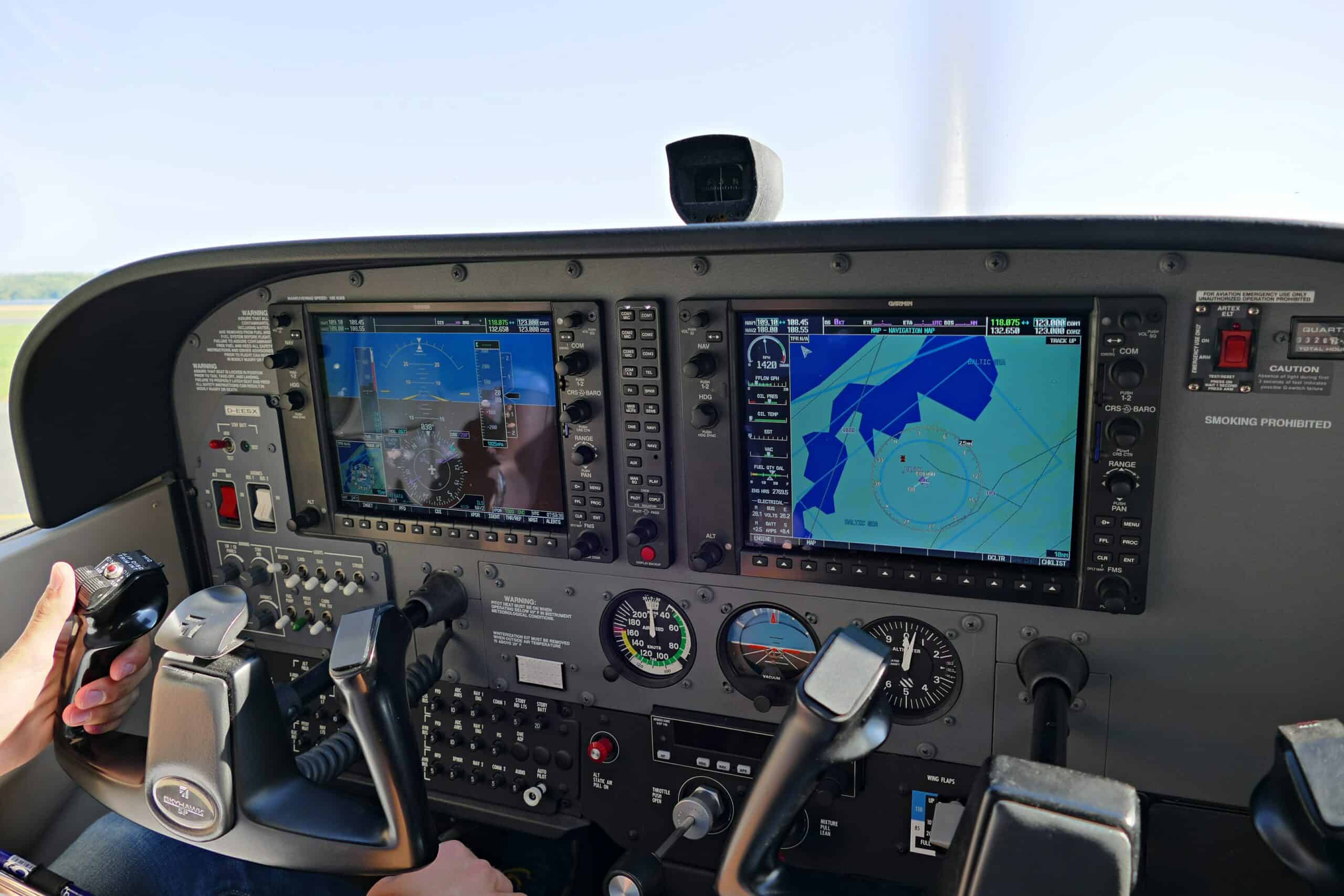
The single biggest evolution in GA thunderstorm avoidance in the last 15 years is in-cockpit datalink weather. ADS-B FIS-B runs on the 978 MHz channel. Paid SiriusXM Aviation is the other path. Every modern panel and every iPad with a Stratus or GDL receiver paints a NEXRAD mosaic over the moving map. It’s a game-changer for strategic deviation. It also kills people who treat it as live radar.
The NTSB published Safety Alert 017 on this exact issue. The key finding: the age indicator shows the age of the mosaic image. Not the age of the actual weather data inside it. The mosaic is assembled from multiple ground radar sites, packaged, transmitted, and rebroadcast on a schedule. By the time the pixel arrives on your panel, the precipitation it depicts can be 15 to 20 minutes old. The screen may still say the image is 2 minutes old.
Honestly, this is where we’d push back on the marketing copy from every cockpit avionics vendor. “Real-time weather” isn’t real-time. In precipitation mode, the minimum effective age is around 8 minutes. In clear-air mode, 13 minutes or worse. For a cell moving at 30 knots, 15 minutes of latency is 7.5 nautical miles of position error. The thing you’re avoiding has already moved off the screen and into your routing.
The rule for datalink NEXRAD is strategic, not tactical. Use it to pick the side of the front you’ll deviate toward 50 miles out. Don’t use it to thread between two cells you can already see in the windshield.

Airborne Radar and Spherics — for the Few Who Have Them
A small slice of the GA fleet carries a real airborne weather radar in the nose or a wing pod. Both tools add range to thunderstorm avoidance work, but neither replaces the underlying discipline. Think high-end Bonanzas, Mooneys, Cirruses, and most cabin-class twins. A smaller slice still carries a Stormscope or Strikefinder spherics receiver. Both are live, and both have rules.
Tilt Management: The Skill Nobody Teaches
Airborne radar is a flashlight, not a floodlight. The antenna sweeps a narrow vertical beam, and the pilot picks where that beam points. Tilt up too high and the beam sails over the tops of the cells, painting nothing. Tilt down too low and the beam paints ground returns and clutter.
The right technique is to tilt up until the painted weather just disappears, then back down a touch. Repeat as range changes. A target at 60 miles needs a different tilt than the same target at 20. Most GA radars have a usable range of 40 to 60 nautical miles. Past that, the signal goes too weak to trust.
Attenuation is the radar pilot’s biggest trap. A dense band of precipitation between you and a worse cell absorbs the radar return. The result is a black shadow that looks like clear air. There is no clear air behind a heavy red return. That shadow is exactly where the next storm is hiding.
Stormscope and Strikefinder Spherics
Spherics receivers detect the electromagnetic discharge from lightning instead of reflected precipitation. The trade-off is real. Spherics see storms before they’re heavy enough to paint on radar, and the data is genuinely live. They don’t see precipitation — only electrical activity.
For a piston-single pilot on a 12-volt panel, spherics paired with datalink NEXRAD is a strong combination. The weight and cost are a fraction of airborne radar. The data isn’t as precise on bearing or range. But the latency is zero, and the unit catches cells while they’re still building.

Microbursts — the Storm You Don’t Have to Fly Through to Die
Microbursts are the part of thunderstorm avoidance most pilots underweight. A microburst doesn’t require the pilot to penetrate the cell. The killing event happens on departure or final approach. The airplane is low, slow, and depending on stable airflow.
The FAA defines a microburst as a downdraft less than 2.5 nautical miles across. Peak intensity lasts only 5 to 15 minutes. The descending air column hits the ground and fans outward as an expanding ring of high-speed wind. An airplane on short final hits a quick headwind boost. Then the core downdraft. Then a sudden tailwind that strips lift away faster than the engine can replace it.
Recognition cues that should send you around immediately:
- A virga shaft visible under a cell — rain evaporating before it reaches the ground is a dry microburst signature
- An expanding ring of dust or debris on the airport — gust front outflow in real time
- A rapid wind shift reported by the tower or AWOS
- Convective activity within 5 miles of the field, even if the cell is moving away
Here’s what most pilots get wrong about microbursts. The reported surface wind from a tower or AWOS comes from a single sensor. That sensor may sit 200 yards from the runway. A microburst is small enough that the sensor can read calm while the threshold is being hit with 50-knot shear. If you can see a virga shaft or a fresh dust ring, go around. The wind report does not get a vote.
The Three Strategies That Actually Work
Every successful thunderstorm avoidance plan reduces to one of three approaches. The pilots who go decades without a convective scare are running one of these on every summer cross-country.
Strategy One: Go IFR for the Routing Flexibility
VFR pilots think IFR locks them into a clearance. The opposite is true around weather. ATC will routinely approve “deviate as required for weather” on an IFR flight plan. They’ll give you radar vectors around convection. They’ll coordinate altitude changes that VFR pilots have to ask for in fragments. The IFR system was built for weather. Use it.
The pilot working through any current IFR currency requirements already has the rating in hand. Filing IFR for a summer cross-country isn’t an admission of trouble. It’s the strategic call that gives you the most options when convection blooms an hour ahead.
Strategy Two: Plan the Hole Before You Need It
Convective weather isn’t random. Cells build in lines along fronts. Along the lee side of mountains. Along the convergence between moist Gulf air and drier continental air. The hole isn’t where you wish. It’s where the front breaks down or where the line hasn’t connected yet.
Brief the convective outlook the night before. Brief it again two hours before departure. Have a primary route. An alternate route 100 miles offset. A divert airport at every hour mark on the plan. The point of running a ForeFlight briefing for thunderstorm avoidance isn’t to find a clear sky. It’s to know where the cells will be when you get there.
Strategy Three: Divert Early or Stay on the Ground
The pilots who get killed by thunderstorms almost never started the flight with a clear, cell-free sky. They started with isolated buildups. They watched the buildups merge into a line. They made the call to “just push through” 45 minutes too late.
Set a personal minimum that triggers the divert. A cell within 30 miles of route. A tops report above 30,000 feet. A Convective SIGMET issued for your sector. Whatever the trigger is, commit to it before departure. The decision to divert at 50 miles out is a small one. The same decision at 5 miles out doesn’t exist.
What AIM 7-1-27 Actually Tells You
The Aeronautical Information Manual section on thunderstorm flying is short, blunt, and ignored. Every line earns its place. The do’s and don’ts for thunderstorm avoidance lifted directly from AIM 7-1-27:
- Don’t land or take off in the face of an approaching thunderstorm
- Don’t attempt to fly under a thunderstorm even if you can see through to the other side
- Don’t attempt to fly under the anvil of a thunderstorm
- Don’t trust the visual appearance to be a reliable indicator of the turbulence inside
- Do ask ATC for radar navigation guidance or to approve deviations around thunderstorms
- Do use datalinked NEXRAD imagery for route selection — strategic, not tactical
If penetration becomes unavoidable — meaning unavoidable, not inconvenient — the same AIM section gives a survival checklist. Tighten the harness. Disengage altitude and speed hold on the autopilot. Hold attitude, not altitude. Slow to maneuvering airspeed (Va). Pick a penetration altitude either below the freezing level or above minus 15 Celsius. The full guidance is in AIM Chapter 7.
Common Thunderstorm Avoidance Mistakes GA Pilots Make
The five errors below show up in NTSB convective-loss reports year after year. None of them are stupid pilots. All of them are smart pilots who treated thunderstorm avoidance as a flexible guideline rather than a hard rule.
- Trusting datalink NEXRAD as if it were live. The pixel on the screen is 8 to 20 minutes old. A line moving at 30 knots has shifted 5 to 10 miles during that latency window. Use NEXRAD for strategy, not for threading between cells.
- Flying through the “sucker hole” between two cells. The space between echoes is where outflow boundaries meet. The shear at that meeting point can exceed the airframe’s gust envelope. AC 00-24C says 40 miles between echoes — read the rule, apply the rule.
- Trusting visual gaps in a line. The cell you can see is the cell that’s building. The cell forming behind the one in front of you is the one you can’t see. By the time you fly into the gap, it isn’t a gap.
- Believing the airplane handles convective turbulence. A Normal-category GA airplane is certified to +3.8 g — a number that assumes smooth-air loading. Mature thunderstorms generate gust loads that exceed +6 g in a single hit. The wing doesn’t unfold gradually.
- Pressing to a non-divertable destination. The pilot who must land at a specific field has already lost the thunderstorm avoidance argument. Connection, meeting, hotel — all bad reasons. Build a flight plan that allows a 200-mile divert without breaking the trip.
Building a Personal Thunderstorm Avoidance Routine
A real thunderstorm avoidance routine isn’t gear. It’s habit. The summer pilot who flies clean every year isn’t the one with the best gear. It’s the one with a habit. Build the habit during winter. Run it on every summer cross-country. The convective-loss statistics stop being something that happens to “other pilots.”
A routine that holds up under pressure looks like this. The night before, pull the prog charts and the convective outlook. Identify the active front and the regions favored for afternoon storms. Pick a launch time that gets you to destination before the diurnal peak. For most of the lower 48, that’s before 2 PM local. Brief the divert airports along the route, paying attention to which way the line will move during your flight.
On the morning of departure, repeat the brief two hours before takeoff. Pull the current Convective SIGMETs, the AIRMET Tango for turbulence, and the latest tops report. Confirm the planned route still works against current data. If it doesn’t, adjust before engine start. Re-briefing in the run-up area with an iPad while burning fuel is not a strategy.
In flight, work the radio. Flight Watch is gone. But Flight Service and ARTCC controllers will hand you PIREP-grade weather information when you ask in plain English. “How are the tops looking 50 miles ahead?” gets a useful answer. So does “Are you painting any cells in front of N12345?” The information is there. Pilots who don’t ask don’t get it.
The community side of this matters too. Pilots who fly the same region year over year build a calibrated sense of how summer weather actually behaves there. What time the cells fire. Where the gaps tend to form. Which airports stay clear longest. Joining the E3 Aviation community connects you with pilots who share that regional knowledge. Dozens of summer cross-countries of experience sit in the room with you.
Frequently Asked Questions About Thunderstorm Avoidance
How far should I stay from a thunderstorm as a GA pilot?
FAA AC 00-24C recommends at least 20 nautical miles from any thunderstorm marked severe or showing an intense radar echo. The same advisory recommends at least 40 nautical miles between two heavy or extreme echoes before flying between them. Treat these as minimums for thunderstorm avoidance, not targets. The 20-mile figure is based on how far hail and severe turbulence escape the radar signature of the cell.
Is my datalink NEXRAD weather actually live?
No. The age indicator shows the age of the mosaic image. It does not show the age of the underlying weather. By the time the picture reaches your screen, the precipitation can be 8 to 20 minutes older than the timestamp. Use datalink NEXRAD for strategic deviation 50 miles out — never for tactical threading between visible cells.
Can I legally fly through an area covered by a Convective SIGMET?
For a Part 91 pilot, yes — Part 91 doesn’t prohibit it. The Convective SIGMET is a weather advisory, not a regulatory closure. That said, every Convective SIGMET implies severe or greater turbulence, severe icing, and low-level wind shear. Legal isn’t the same as wise. Plan thunderstorm avoidance around the published SIGMET area, not through it.
Our Take on Summer Convective Flying
Thunderstorm avoidance separates the GA pilots who keep flying from the ones featured in the next ASI Nall Report. The skill set isn’t complicated, but it is unforgiving. The cell doesn’t care that you have a meeting. The wing doesn’t care that your last 200 hours were smooth.
The pilots who get this right share three traits. They brief weather like their flight depends on it (because it does). They treat datalink NEXRAD as a strategic tool with known latency, not as a live radar feed. And they accept the divert before they need the divert. The alternative is what the accident reports describe. Pressing to a closed destination through a line that has now connected.
Want more practical, no-fluff content on weather, training, ownership, and the GA lifestyle? Become an E3 Aviation Association member. We’re built by pilots, for pilots. Summer convection is the kind of topic we cover the way it deserves to be covered.
Further Reading on E3 Aviation
- ForeFlight Complete Guide for GA Pilots (2026)
- IFR Currency Requirements: The Complete 2026 GA Guide
- Density Altitude: The Complete GA Pilot Guide for 2026
- Stall Recognition and Recovery: A GA Pilot’s 2026 Guide
- How to File a VFR Flight Plan: A GA Pilot 2026 Guide
- Aircraft V-Speeds: Every GA Pilot’s Quick Reference
- Cessna 172: The Complete Owner and Pilot Guide for 2026