Last Updated: July 2, 2026 | By E3 Aviation Editorial Team
Every GA pilot has done it. You dial up the frequency in ForeFlight. A robot voice recites winds. You blindly trust the number. Then you turn base and the windsock tells a different story. That mismatch is almost always a misread of ATIS vs AWOS vs ASOS. Three sources sound similar. They share phrasing. They quietly do very different things.
This guide breaks down ATIS vs AWOS vs ASOS the way we wish it had been taught to us. What each system measures. How each report gets built. Where each one lies. And the gotchas that turn a routine arrival into a briefing failure. You’ve flown for a decade. You still can’t articulate the difference between an AWOS-3P and an augmented ASOS. This is for you.
Why ATIS vs AWOS vs ASOS still trips up GA pilots
The confusion isn’t your fault. It’s baked into the way we learn weather.
Primary training teaches you to pull the ATIS at your towered airport and read it back to ground. That’s fine at KAPA or KFTY. But then you land at an untowered field with an AWOS-3PT. The phraseology shifts. The reporting cadence changes. Half the codes you memorized don’t apply. Then you fly to a joint-use field where ASOS is primary. A controller reads it as if it were ATIS. Same voice. Same rhythm. Very different sensor stack behind the mic.
Here’s the punchline. ATIS vs AWOS vs ASOS isn’t about accuracy. All three can be dead accurate. It’s about the data source behind the report. Who is augmenting it. How often it updates. What it will refuse to tell you. Miss one of those four dimensions and you’ll get bit.
We’ll be straight with you: the FAA doesn’t publish a single clean side-by-side comparison. So pilots learn ATIS vs AWOS vs ASOS through folklore, checkride prep, and the occasional bad landing. Let’s fix that.
What ATIS actually is (and what it isn’t)
Automatic Terminal Information Service is the oldest of the three. It’s a recorded broadcast, originally taped and now digital. A tower or approach controller updates it at the top of each hour. Or sooner when conditions change. Per FAA AIM 4-1-13, ATIS is designed to reduce frequency congestion. It pushes routine arrival and departure data onto a separate frequency.

ATIS is a controller product. That matters. In the ATIS vs AWOS vs ASOS lineup, only ATIS is guaranteed to be curated by a human. The controller looks at multiple sources. Tower cab observation. ASOS or AWOS feed. NOTAMs. Taxiway closures. Current runway configuration. The controller writes the script. The controller cuts the tape.
What ATIS is not: it’s not real-time. It’s a snapshot. On a quiet day it can be up to an hour old. It’s also not a sensor. When you hear “wind two-seven-zero at eight” on ATIS, the tower is reading a wind display. That display is fed by an underlying sensor. Usually an ASOS or a dedicated airport wind sensor. The number is locked in until the next update.
Key detail most pilots miss. The phonetic identifier on ATIS (Information Alpha, Information Bravo) is not just a naming convention. It tells the controller you’ve heard the current broadcast. Give the wrong letter and you’ll get the full weather block again on frequency. That congests exactly the airspace the system was built to protect.
AWOS decoded: the flavors, the frequencies, the traps
Automated Weather Observing System is the FAA’s answer to weather at airports without a tower. Or without staffed weather observers. Or that need a supplemental data source alongside ATIS. In the ATIS vs AWOS vs ASOS conversation, AWOS is the one you’ll hit most at smaller GA fields.

There isn’t one AWOS. There are six flavors, and the number and letter matter.
AWOS-A reports altimeter setting only. That’s it. If you fly to a field with an AWOS-A, you’ll get a barometric pressure and nothing else. Old, uncommon, but they still exist.
AWOS-1 adds wind, temperature, dewpoint, and density altitude to the altimeter setting.
AWOS-2 adds visibility.
AWOS-3 adds cloud height and sky condition.
AWOS-3P adds precipitation type — rain, snow, freezing rain.
AWOS-3PT adds a thunderstorm sensor. This is what you want when the convection is on the horizon.
The trap. Two nearby airports might both publish “AWOS” on the approach plate but run very different sensor suites. One is an AWOS-3PT. One is an AWOS-1. The information you get is not the same. Check the Chart Supplement before every arrival at an unfamiliar untowered field. It lists the exact AWOS type. It also lists the phone number to dial from the ground.
Second trap. AWOS updates every minute for most parameters. But only every 5-10 minutes for cloud and visibility. Convective weather can jump the ceiling by 500 feet in the gap. AWOS won’t tell you until the next cycle.
ASOS explained: the NWS system pilots also use
Automated Surface Observing System is the joint FAA/NWS/DoD sensor network. It produces the surface weather backbone for the country. When you pull a METAR for a major airport, that METAR is almost certainly built from an ASOS station. In the ATIS vs AWOS vs ASOS trio, ASOS also feeds the National Weather Service forecast pipeline.
ASOS sites are jointly operated. NWS owns most of them for weather forecasting. The FAA runs the aviation-facing subset at towered and joint-use airports. Per the NWS ASOS technical description, the sensor suite is deep. Ceilometer. Visibility sensor. Precipitation identifier. Freezing rain sensor at select sites. Thunderstorm sensor. And a shielded temperature/dewpoint pair to defeat solar heating.
The important difference from AWOS: ASOS can be augmented. Human observers at many ASOS sites can override or add to the automated report. Reporting virga the sensor missed. Correcting a low cloud call. Adding remarks about a distant lightning display. AWOS is pure automation. ASOS is often automation plus a human backstop.
That backstop matters when it matters. A summer downdraft rolls through. The sensor briefly reads calm before the outflow arrives. An augmenting observer at an ASOS site can note the discrepancy in a special observation. AWOS won’t do that. It’ll wait for the next update and give you the reading after the outflow has passed.
Where ASOS reports show up. On CTAF at some untowered joint-use fields. On a dedicated frequency at towered airports (feeding the ATIS). On the phone (dial the ASOS number in the Chart Supplement). And in every METAR that carries an “AUTO” or “COR” flag. When you decode weather on how to read a METAR, you’re usually decoding ASOS output. The ASOS User’s Guide catalogs the exact codes.
ATIS vs AWOS vs ASOS side by side
Here’s the compressed version. Learn this and you’ll never mix them up again.
ATIS. Controller-recorded. Updated hourly or on significant change. Contains weather, active runway, notable NOTAMs, altimeter, and an identifying letter. Towered fields only. Not real-time. Curated by a human.
AWOS. Fully automated. Updates every minute for wind and altimeter. Every 5-10 minutes for visibility and ceiling. No human curation. Untowered fields, small towered fields, and as a supplemental source. Six variants. Check the Chart Supplement for the exact type.
ASOS. Joint FAA/NWS/DoD. Fully automated with human augmentation available at many sites. Feeds official METARs. Denser sensor suite than AWOS. Updates every minute. Available at large towered airports and many mid-sized regional fields.
Our take. For a routine arrival at a Class D or Class C, all three lineups produce a workable report. The ATIS vs AWOS vs ASOS difference starts to matter when the weather is marginal. Or when convection is nearby. Or when the ceiling is close to your minimums. Or when the surface wind is doing something the report should catch but might miss.
The identifier trick that saves you 30 seconds
Every ATIS broadcast opens with the airport identifier and phonetic letter. “Charlotte information Kilo.” AWOS and ASOS broadcasts open with the identifier and a time stamp. “Roswell AWOS 1653 Zulu.” Learn to catch that opening in three seconds. You can skip re-listening if you already have current data. Small habit. Big saved workload on a busy arrival.
How to actually get the report — frequency, phone, ForeFlight
Three ways to pull an ATIS, AWOS, or ASOS report. Each has a use case. Each has failure modes.
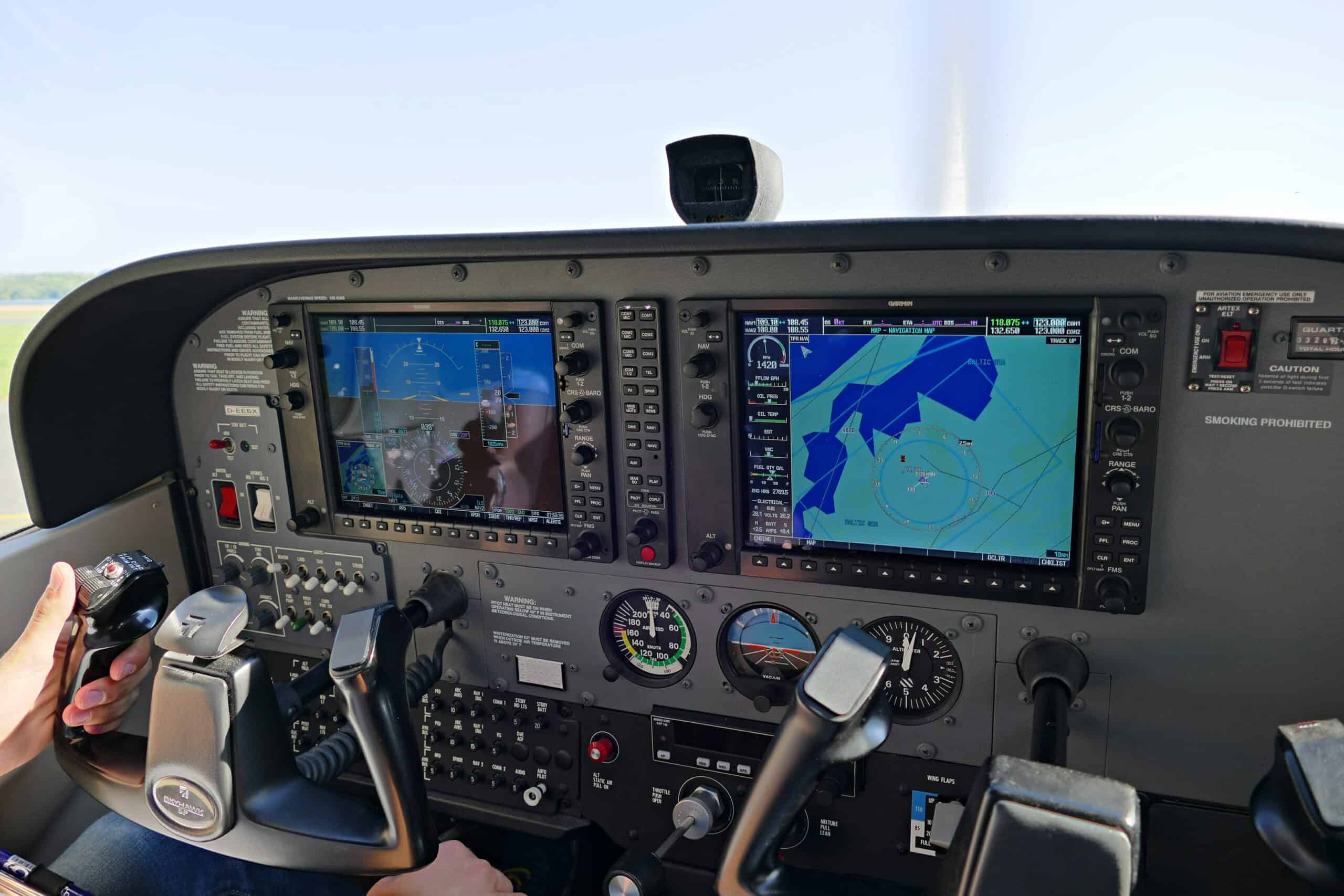
On frequency. The standard. Tune the ATIS or weather frequency 20-30 miles out. It’s listed on the approach plate or Chart Supplement. If it’s an AWOS on a discrete VHF, the signal is line-of-sight and often weak at range. Get closer or climb a couple thousand feet if you can’t copy. ATIS vs AWOS vs ASOS on frequency all sound similar. Check the identifier and time stamp to confirm which one you’re hearing.
On the phone. Every ASOS and most AWOS installations publish a phone number in the Chart Supplement. Call it from the ground during preflight for a real-time report. This is how you check ceilings and visibility without waiting for the METAR cycle. Cheap habit. High payoff on marginal-weather days.
Through ForeFlight or Garmin Pilot. The METAR you see is a text version of the underlying ASOS or AWOS report. It refreshes every few minutes over ADS-B In or cellular. The ATIS is not there. You still need to tune ATIS on frequency. That’s where the runway assignment, NOTAMs, and current altimeter come from.
The “we can’t hear the AWOS on the ground” problem
Common on ramp-side preflights. The AWOS frequency is dead on your handheld. That’s because most AWOS transmitters are line-of-sight VHF. The antenna is masked by a hangar or a hill. Fix: use the phone number. Every AWOS in the Chart Supplement has one. This is the ground workaround pilots forget exists.
Where each system quietly lies to you
Every automated report has failure modes. Understanding them separates good weather decisions from blind trust. When you compare ATIS vs AWOS vs ASOS on failure modes, they’re not equal.
ATIS lies by being stale. A tower can leave the same recording up for 55 minutes if conditions haven’t changed enough to trigger an update. The number you hear may reflect weather from an hour ago. On a fast-moving front, that’s a lifetime.
AWOS lies by refusing to see certain things. An AWOS-3 with no thunderstorm sensor won’t call a lightning cell 5 miles east. The sensor doesn’t exist. An AWOS with a fouled ceilometer or iced visibility sensor may report clear skies during a scud layer. If the identifier is missing from the report, that’s the AWOS telling you it can’t verify its own broadcast.
ASOS lies by averaging. The one-minute wind is an average. Not a peak. Gust reporting kicks in at specific thresholds. But a 5-knot spike lasting 20 seconds can vanish from the report entirely. On a gusty crosswind day, treat the reported wind as a floor. Not a ceiling.
All three can lie by omission when a sensor fails. The report may still come through. Just missing the ceiling. Or the visibility. Or the precipitation type. Listen for the silence. If you expect to hear cloud height and don’t, the ceilometer is out. Cross-check with satellite or a PIREP.
This is the sensor-reality gap that pairs with our earlier work on lightning detection and reading PIREPs. The sensors are inputs. Your job is to build the picture.
Our take: the pilot’s playbook for ATIS vs AWOS vs ASOS
Here’s what most pilots get wrong. They pull one report and treat it as truth. The right workflow is layered.
Before takeoff, pull the destination METAR (ASOS or AWOS output). Then dial the phone number if you have any doubt. Two sources cross-checked before you’re airborne.
Enroute, get a PIREP if the METAR looks marginal. Use it to correct what the automated sensor might have missed. Especially on days with fog formation and forecasting in play. Or when AIRMETs and SIGMETs are active.
Arriving, tune ATIS 25 miles out. Note the identifying letter. Cross-check the wind against your ground track. Look for surface indicators. Smoke. Water ripples. The windsock as you enter the pattern.
At an untowered field with only AWOS, do all of the above. But also monitor the CTAF for another pilot’s real-time report. Someone in the pattern 5 minutes ahead has fresher data than the AWOS cycle. That’s the whole point of CTAF. See our field guide on CTAF vs UNICOM for the mechanics.
Honestly, this is where we’d push back on the “just trust the automation” school. ATIS vs AWOS vs ASOS are tools. Great tools. But they’re all pre-filtered snapshots of an atmosphere that doesn’t care about your update cycle. Your eyes and fellow pilots on frequency are the closing check.
The habit that ties this together is layered checks, not blind trust. It’s the same habit in VFR cross-country planning. The same habit that keeps pilots alive on marginal days. Learn it once. Apply it every flight.
Frequently asked questions
Is ATIS more accurate than AWOS or ASOS?
No. But it’s usually more useful. ATIS pulls its weather data from the same ASOS or AWOS sensor stack. So the underlying numbers are identical. The value ATIS adds is human curation. Active runway. Current NOTAMs. The identifying letter that confirms you’ve heard the latest broadcast. In ATIS vs AWOS vs ASOS accuracy terms, the sensors are the truth. ATIS is the wrapper.
Why does the AWOS sometimes disagree with the METAR at the same airport?
Two reasons. First, timing. The METAR may be 15-40 minutes old. The AWOS you just heard is current. Second, at some fields the METAR is generated by a different sensor than the pilot-facing AWOS broadcast. Check the time stamp on both. The one closer to now wins.
Can I fly a legal instrument approach with an AWOS report?
Yes, at fields where the AWOS is the official weather source. The AWOS report must include the required elements. Altimeter. Wind. Visibility. If any of those elements is missing from the broadcast, the approach may not be usable. Sensor failures make this happen more often than you’d think. The approach plate notes spell out what’s required for each specific procedure.
Related articles
- How to Read a METAR and TAF: A Pilot’s Complete Weather Guide
- Reading PIREPs: The 2026 GA Pilot Field Guide
- Fog Formation and Forecasting for GA Pilots: The 2026 Complete Guide
- Reading AIRMETs and SIGMETs: The 2026 GA Pilot Guide
- Lightning Detection for GA Pilots: The 2026 Stormscope Guide
- CTAF vs UNICOM: Airport Frequency Guide for Pilots
- VFR Cross-Country Planning: The 2026 GA Pilot Guide