The Diamond DA40 is the four-seat single most GA pilots underestimate the first time they climb in, then can’t stop talking about the first time they climb out. It looks unusual — long slim wing, bubble canopy, T-tail on the older birds, sleek all-composite airframe — and it flies the way it looks: light, honest, and stable. But the reason the DA40 has stayed on Diamond’s line for 25 years and now flies in flight schools on five continents isn’t the styling. It’s the numbers: one of the lowest fatal accident rates of any general aviation aircraft, 5-7 gph fuel burn on the diesel NG, and a modern Garmin G1000 NXi panel that would cost six figures to graft onto an equivalent-vintage Cessna.
We’ll walk through what the Diamond DA40 actually is, how the current lineup breaks down, what it costs to buy and operate in 2026, what the numbers say about its safety record, how it flies day-to-day, and where it fits — and doesn’t fit — in a real GA mission profile.
What the Diamond DA40 Actually Is
The Diamond DA40 is a four-seat, fixed-gear, single-engine piston built almost entirely from composite. Diamond Aircraft Industries first certified the DA40 Diamond Star in 2000 as a modern replacement for the tired 1960s-vintage Cessna and Piper trainers dominating the four-seat market. The airframe was clean-sheet — carbon fiber and glass fiber laminate, high-aspect-ratio wing, huge canopy, T-tail on early models, conventional cruciform tail on later ones — and it introduced glass avionics to the primary trainer segment years before the legacy manufacturers caught up.
Today Diamond sells two main variants: the piston-avgas DA40 XLT (Lycoming IO-360, 180 hp) and the diesel DA40 NG (Austro Engine AE 300, 168-180 hp, burning Jet-A). Both use the same airframe, same wing, same G1000 NXi panel. The engine choice drives the price, fuel burn, mission profile, and — for a growing number of owners — the answer to the “what happens when 100LL goes away” question.
Diamond DA40 Model Variants Explained
Twenty-five years of production have generated a lineup that confuses even Diamond dealers. Here’s the short version, because “DA40” alone tells you almost nothing about the airplane in front of you.
DA40 (2000-2003) — the original. Lycoming IO-360, 180 hp, six-pack analog panel, T-tail. Now a bargain used option for pilots comfortable retrofitting.
DA40 Diamond Star XL / XLS (2004-2010) — G1000 glass panel replaced the six-pack. Conventional tail replaced the T-tail. Best-value used sweet spot for pilots who want the G1000 and 180-hp Lycoming without a $600K sticker.
DA40 XLT (2011-present) — the current avgas model. G1000 NXi, GFC 700 autopilot, upgraded interior, minor aerodynamic cleanup. This is what a new Lycoming Diamond DA40 looks like on the ramp today.
DA40 TDI (2002-2011) — the first-generation diesel, powered by the Thielert Centurion 1.7. Fuel efficient and Jet-A capable, but Thielert’s 2008 bankruptcy left owners scrambling for parts and TBRs. Buy one only with eyes open and a maintenance plan.
DA40 NG (2010-present) — the current diesel. Austro Engine AE 300 (a clean-sheet Mercedes-derived 2.0L turbodiesel, 168-180 hp depending on year) driving a constant-speed MT propeller. This is the Diamond DA40 that most 2026 buyers are actually shopping.
Engine Options: Lycoming IO-360 vs Austro AE 300
Every Diamond DA40 buying decision starts here. The airframes are identical. The engines are not.
The Lycoming IO-360 in the XLT is the same fuel-injected 180-hp four-cylinder that lives under the cowl of a Cessna 172SP, a Piper Archer, and half the training fleet in North America. Parts are cheap. Every A&P has worked on one. TBO is 2,000 hours. Fuel burn is 8-10 gph in cruise on 100LL. The failure modes and maintenance rhythms are the best-understood in GA piston aviation. Our propeller overhaul guide covers the constant-speed prop that comes with it.
The Austro AE 300 in the NG is a different animal. It’s a 2.0-liter Mercedes-derived turbodiesel with FADEC (single-lever power control, no mixture, no prop), running on Jet-A. Fuel burn in cruise is 5-6 gph. That’s not a typo — the same 130-140 KTAS cruise, on 40% less fuel, in a fuel type that costs less per gallon and won’t disappear when 100LL finally sunsets. Our diesel engines owner guide walks through the trade-offs (higher acquisition cost, gearbox inspection intervals, fewer shops that will touch it) that any NG buyer needs to understand before signing.
Diamond DA40 Specs and Performance
Numbers below are current-production DA40 NG at max gross. Older DA40s and the XLT vary slightly — always confirm against your specific POH.
- Max takeoff weight: 2,888 lb (NG); 2,646 lb (older XL/XLS)
- Empty weight (typical NG): ~1,980 lb
- Useful load: ~900 lb (NG); ~850 lb (XLS)
- Full-fuel payload: ~680 lb with 39.6 gal usable diesel
- Fuel capacity: 41.0 gal total / 39.6 gal usable (NG standard); 50 gal optional long-range
- Cruise (75% power, 8,000 ft): 130-135 KTAS (NG); 140-147 KTAS (XLT)
- Fuel burn (economy cruise): 5.5-6.5 gph Jet-A (NG); 8-9 gph 100LL (XLT)
- Range (economy, no reserve): 900-940 nm (NG); 750-800 nm (XLT)
- Service ceiling: 16,400 ft
- Takeoff roll (sea level, standard): 1,214 ft (NG)
- Landing roll: 750 ft
- Glide ratio: ~14:1 (best-in-class for GA singles)
Diamond DA40 V-Speeds Every Pilot Should Memorize
From the current DA40 NG checklist. Older gasoline variants differ slightly — verify against your AFM.
- VSO (stall, landing config): 52 KIAS
- VS (stall, clean): 53 KIAS
- VR (rotation): 59 KIAS
- VX (best angle): 64 KIAS
- VY (best rate): 66 KIAS
- VFE (max flaps): 108 KIAS takeoff / 91 KIAS landing
- VA (maneuvering): 108 KIAS above 2,161 lb; 94 KIAS below
- VNO (max structural cruise): 129 KIAS
- VNE (never exceed): 178 KIAS
The Panel: G1000 NXi Standard
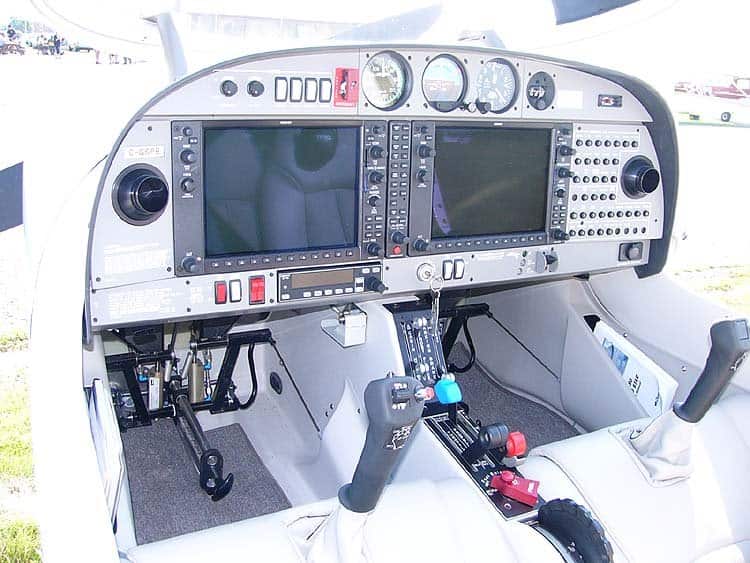
Every current-production Diamond DA40 ships with the Garmin G1000 NXi: dual 10-inch displays, GFC 700 three-axis autopilot, WAAS-capable GPS, ADS-B In and Out, engine-monitoring integrated on the MFD, and full FIS-B weather and traffic. That is a $150K panel in a legacy retrofit — see our G3X touch retrofit cost guide for what glass costs when it’s not baked into the airframe from day one.
The G1000 NXi in the DA40 also drives ESP (Electronic Stability and Protection), which nudges the flight controls back toward level flight if bank or pitch exceeds preset thresholds. It’s not autopilot — it works when the AP is off — and it’s saved lives in disorientation events. For pilots stepping up from a steam-gauge trainer, the transition curve is real. Add another 5-10 hours of dedicated G1000 training and treat your ForeFlight setup as a serious co-brief, not a rental-car GPS.
How the Diamond DA40 Actually Flies
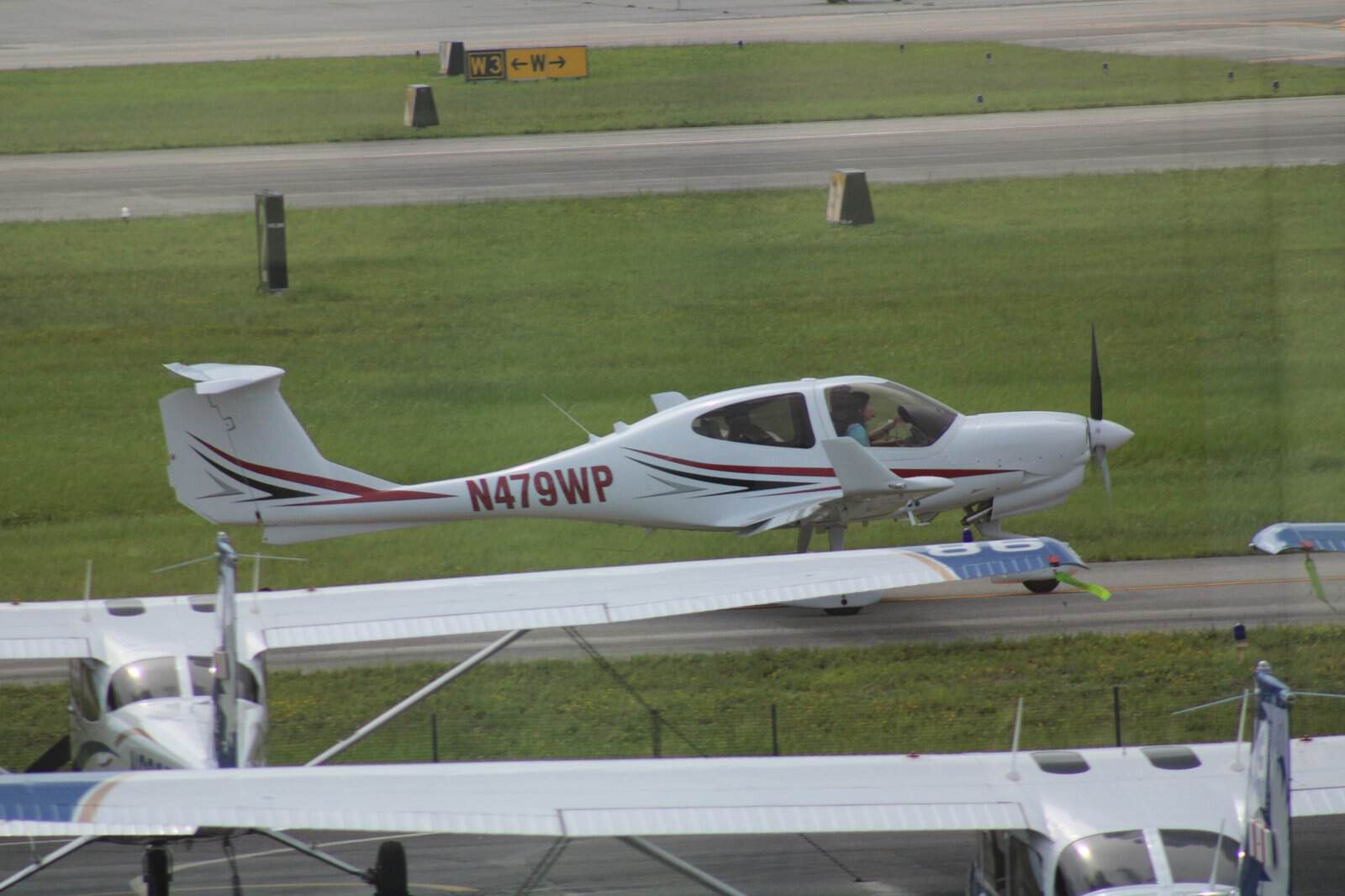
Three things stand out on your first hour in a DA40. First, the visibility from that bubble canopy is unlike anything in a Cessna or Piper — you feel like you’re sitting on the nose. Second, the ailerons are light and effective; you’ll over-control on your first few landings. Third, the airplane is honest at the stall. It gives a clear buffet, breaks straight ahead with no wing drop tendency, and recovers cleanly with power and forward pressure. Our stall recognition and recovery guide is worth reading before your first flight.
The long, high-aspect-ratio composite wing is the reason the DA40 glides at ~14:1. That’s better than a Cessna 172 by roughly 25%. In an engine-out at 5,000 ft AGL you have almost 12 nm of options — that’s a real safety margin. It’s also the reason the airplane feels reluctant to slow down on final; a stabilized approach at 68-70 KIAS with a specific power setting is the trick, and Diamond instructors drill it hard from lesson one.
Handling in gusty crosswinds is the one area where new DA40 pilots complain. The long wing catches gusts, and the light control forces mean you have to fly the airplane through the flare — not just aim it. Once you get 20-30 hours in type, it becomes second nature. Until then, respect published crosswind limits and pick a wider runway.
Diamond DA40 Safety Record
This is where the DA40 wins on paper and in the accident database. Analyses from Aviation Consumer and independent researchers have repeatedly placed the Diamond DA40 at or near the top of the light-single safety rankings.
The commonly cited numbers: 0.35 fatal accidents per 100,000 hours for the DA40 — versus roughly 1.2 for GA as a whole and 3.25 for the Cirrus SR20/22 line (which itself is far from the worst). A separate fleet-hours analysis put the DA40 at 4.0 total mishaps per fleet unit versus 17.3 for the Cessna 172 across comparable training missions.
Why? Four design decisions:
- 26G energy-absorbing seats that turn survivable crashes into walk-away crashes.
- Composite airframe engineered to deform and dissipate crash energy without collapsing the cabin.
- Fuel cells in the wing (not a wet-wing sump) that have kept the DA40 out of post-crash fires — a rare distinction in the piston fleet.
- Benign stall behavior and a ~14:1 glide ratio that give the pilot time to think.
None of that makes the airplane immune. Pilot-induced accidents — VFR into IMC, fuel starvation, runway loss of directional control — still happen in DA40s. The airplane can’t fix a bad decision. But the airframe is engineered to protect you when things go wrong.
Cost of Ownership in 2026
Ballpark pricing on a Diamond DA40 in mid-2026:
- New DA40 NG (factory-fresh): $720,000-$780,000 typically equipped
- Used DA40 XLT (2015-2020): $380,000-$520,000
- Used DA40 XLS (2005-2010, G1000): $250,000-$360,000
- Used DA40 NG (2011-2018): $340,000-$480,000
- Original DA40 (2001-2003, analog): $180,000-$240,000
Direct operating costs run in the $110-$180 per flight hour range for the NG (Jet-A at ~$5.50/gal, oil, engine reserve, annual amortization). The XLT with the Lycoming runs $140-$210 per hour depending on avgas prices in your region. Fixed costs — insurance, hangar, annual, database subscriptions, GPS updates — add $8,000-$15,000 per year before you turn a prop.
Insurance for a DA40 with a mid-time pilot typically runs $2,500-$4,000 annually for the NG; the XLT is slightly less because underwriters know the Lycoming better. Newly rated pilots with 200-500 hours can expect the upper end of those bands; 1,500-hour instrument-rated owners get the lower end.
Maintenance Reality
The DA40 is not a legacy Cessna in maintenance terms. Composite airframes require A&Ps trained in composite repair — not every shop qualifies. Diamond Aircraft has a service center network, but if you’re basing in the middle of the country, plan on ferrying to a proper Diamond shop for major work.
Annual inspection on a DA40 typically runs $2,500-$4,500 for a clean airplane — comparable to a Cessna 172. Add in the borescope inspection on cylinders and the standard alternator and electrical checks, and the annual bill lands in the range every owner budgets for.
The AE 300 diesel in the NG has a different maintenance rhythm than the Lycoming. Gearbox inspection at 300 hours. TBR (time between replacement) on the engine at 1,800 hours — Austro replaces the engine as a unit, they don’t overhaul it in place. That sounds expensive, and it is: budget $65,000-$85,000 for the exchange. Amortize it over 1,800 hours and the reserve is roughly $40 per hour — competitive with a Lycoming overhaul reserve when you factor in the fuel savings.
Who the Diamond DA40 Is Right For
The DA40 is the right airplane if you are:
- A flight school or university buying a modern trainer fleet where safety-per-dollar and low fuel cost matter over a 15-year ownership window.
- A private owner-pilot who wants the safest four-seat single you can buy, a modern glass panel, and a family-hauler for 300-500 nm trips.
- An IFR-rated owner-pilot who values the G1000 NXi + GFC 700 + ESP stack and would pay six figures to add it to a legacy airplane anyway.
- A pilot outside the US or in a state where 100LL is on the way out, and Jet-A availability is the strategic bet.
Who the Diamond DA40 Isn’t Right For
Skip the DA40 and look elsewhere if you are:
- A hard-core cross-country pilot flying 900+ nm legs regularly — a Cirrus SR22 or Bonanza will do it faster and with more cabin.
- A backcountry pilot who lands on grass strips shorter than 1,500 ft — the long wing and low-slung mains aren’t happy in rough terrain (a Cessna 206 is the right tool).
- A budget-first buyer looking under $150K — a well-maintained Cessna 172 or Piper Cherokee is a much better use of capital.
- An owner who wants the largest possible national A&P network — the Lycoming/Continental world is bigger than the Austro world by an order of magnitude.
Diamond DA40 vs the Cessna 172 (The Question Everyone Asks)
The Cessna 172 and DA40 fly the same 300-500 nm mission profile and land on the same runways. The differences that matter:
- Cruise speed: DA40 wins by 15-25 knots depending on model.
- Fuel burn: DA40 NG wins on Jet-A (~5.5 gph vs ~8.5 gph on 100LL).
- Panel: DA40 wins with standard G1000 NXi + GFC 700 + ESP.
- Safety record: DA40 wins on fatal-accidents-per-hour.
- Visibility: DA40 wins on the bubble canopy.
- Acquisition cost (used): Cessna 172 wins — a clean mid-time 172SP is $180-240K; a comparable DA40 XLS is $250-360K.
- Parts and A&P availability: Cessna 172 wins by miles.
- Backcountry / short-field: Cessna 172 wins on rough surfaces and shorter runways.
- Insurance: Cessna 172 usually wins on premium.
Common First-Owner Mistakes
Five things new DA40 owners get wrong, in the order they typically get wrong:
- Under-training on the G1000 NXi. Book 5-10 dedicated hours with a Diamond-experienced CFI, not a rental checkout. The autopilot logic and ESP behavior take time to internalize.
- Landing too fast. The DA40 wants 68-70 KIAS on short final. Add 10 knots “for safety” and you’ll float halfway down the runway. Stabilize on the speed the POH gives you.
- Ignoring the gearbox inspection on the NG. Miss the 300-hour gearbox check and you’re voiding the engine warranty. Put it on the calendar the day you take delivery.
- Cheap out on the pre-buy. Composite airframes hide damage differently than aluminum. A Diamond-experienced shop for the pre-buy is worth every dollar.
- Assume “diesel” means “no cold-weather care.” The AE 300 needs Jet-A additive management and preheat procedures in cold weather. Read the AFM. Twice.
Diamond DA40 FAQ
Is the Diamond DA40 hard to fly?
No — the DA40 is widely considered one of the easiest four-seat singles to fly well. Stall behavior is benign, controls are light and predictable, and the visibility is excellent. The two things that catch new pilots are the tendency to over-control the light ailerons in the first few landings and the discipline required to hit exact approach speeds. Neither is a deal-breaker; both fade after 15-25 hours of type-specific instruction.
Can a private pilot fly a Diamond DA40 without a type rating?
Yes. The DA40 is a single-engine, fixed-gear, non-high-performance airplane under 200 hp, so it requires no type rating and no high-performance endorsement. However, insurance underwriters and reputable flight schools require a Diamond-specific checkout — typically 5-10 hours dual with a CFI experienced on the airframe and the G1000 NXi — before releasing an aircraft or a policy.
Is a used Diamond DA40 a good first airplane?
For a well-trained instrument-rated pilot with 200+ hours and a budget in the $250K-$500K range, yes — a used DA40 XLS or XLT is one of the strongest first-airplane values on the market. The safety record, glass panel, and fuel economy are hard to beat. For a fresh private pilot with 60 hours total time and a tight budget, a clean Cessna 172 will teach you more per dollar and cost less to insure while you build hours.
Our Take
The Diamond DA40 sells against the same buyer decision as every other modern four-seat single: what are you actually trying to do, and how much airframe do you need to do it? For pilots who want the safest four-seat single you can buy new, a G1000 NXi panel that costs six figures as a retrofit, and 5-6 gph fuel burn on a fuel type that isn’t going away — the DA40 NG is the answer, and it isn’t close. For pilots who don’t need any of that, a well-maintained Cessna or Piper will fly you the same missions for half the acquisition cost.
Every airframe carries a tradeoff sheet. The DA40’s tradeoff — higher acquisition cost, smaller A&P network, tighter approach discipline required — is one a lot of serious owner-pilots have decided is worth paying. The safety numbers, the fuel-burn numbers, and 25 years of production say that decision has been the right one for a lot of people. Read the POH, take the type-specific dual, and get honest with yourself about the mission. That’s how you buy the right airplane, whether it wears a Diamond emblem or not.
Related Articles
- Cessna 172 Complete Pilot Guide
- Piper Cherokee Complete Pilot Guide
- Cirrus SR22 Complete Pilot Guide
- Cessna 206 Stationair Complete Pilot Guide
- Cessna 150 Complete Pilot Guide
- Diesel Engines for General Aviation: Owner’s 2026 Guide
- Aircraft Propeller Overhaul: GA Owner Guide
- Borescope Inspection: GA Owner’s Cylinder Guide
- Alternator vs Generator: GA Electrical Primer
- G3X Touch Retrofit: 2026 Cost Guide
- ForeFlight Complete Guide for GA Pilots
- Stall Recognition and Recovery
- Avgas Prices 2026