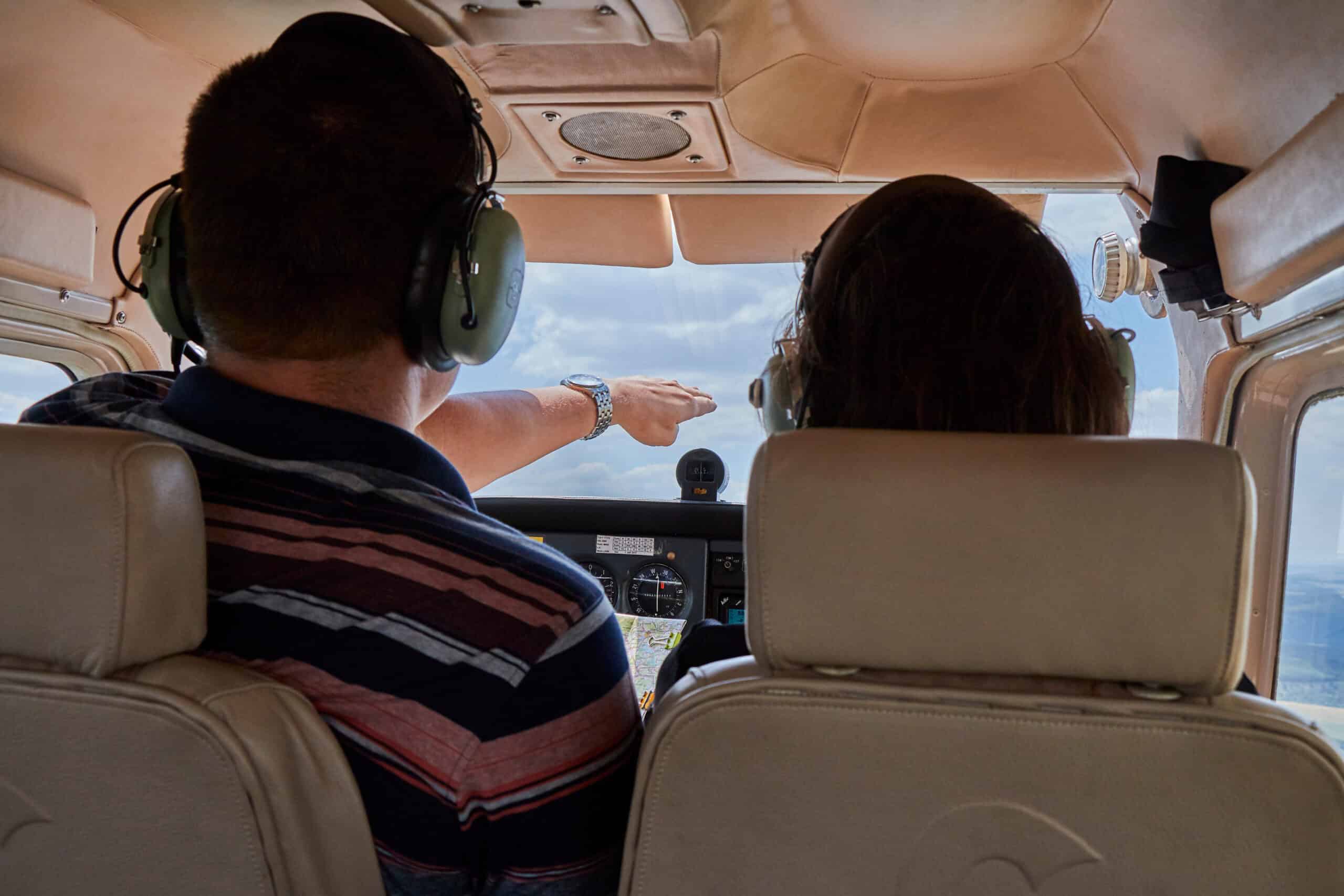
Aviation emergency mindset separates pilots who manage unexpected situations effectively from those who freeze, fixate, or make a bad situation worse. The physical skills matter: stick-and-rudder work, systems knowledge, checklist execution. But research into real accident chains consistently shows that how a pilot thinks under stress is at least as important as what they know technically. Developing the right aviation emergency mindset isn’t about hoping for the best — it’s about structured mental preparation that kicks in before the adrenaline does.
Last Updated: May 7, 2026 | By: The E3 Aviation Editorial Team
What Research Says About Pilots Under Stress
Aviation psychology research is clear on several points. First, stress narrows attention. When something goes wrong, the brain defaults to tunnel vision, fixating on the most alarming element while filtering out surrounding information. Second, task saturation — being overwhelmed with simultaneous demands — degrades decision quality fast. Third, pilots who have mentally rehearsed emergencies respond more effectively than those who haven’t, even when they’ve never faced that specific situation before.
The NTSB’s aviation accident data consistently identifies loss of situational awareness, fixation, and poor decision-making as primary contributors to accidents that began as manageable situations. That finding points directly to this mindset as a trainable factor, not a fixed personality trait.
Why Technical Knowledge Alone Is Not Enough
Every instrument-rated pilot knows the procedure for a vacuum pump failure. It’s in the POH and covered in instrument ground school. But knowing the procedure in a classroom versus executing it calmly while managing ATC, informing passengers, and selecting an alternate are entirely different cognitive challenges.
The gap between knowing and doing under stress is exactly where this mental framework training lives. As a result, a pilot who has mentally walked through vacuum failures at home will reach for the backup attitude indicator faster and with more confidence than someone who has only read the procedure. Mental rehearsal builds the neural pathways that acute stress tends to degrade. This is why astronauts, surgeons, and military pilots all use it without apology.
Aviate, Navigate, Communicate: The Priority Framework
The aviate, navigate, communicate framework exists because pilots under stress lose track of priorities. Without a mental anchor, it’s easy to get absorbed in communicating with ATC while the aircraft drifts off heading or loses altitude. The framework solves this by establishing an unambiguous order of operations with no room for ambiguity under pressure.
Aviate first: fly the aircraft. Everything else is secondary to maintaining control. Navigate second: know where you are and where you can safely go, particularly in relation to terrain and suitable landing areas. Communicate third: ATC needs to know your situation, but they wait until the first two are handled and stable.
Applying the Framework When It Is Not Clear-Cut
The framework seems simple until you’re in a situation where the tiers overlap. Consider partial power loss in IMC near terrain. You’re simultaneously managing aircraft control, figuring out whether to descend below the cloud layer or hold altitude above terrain, and deciding whether to declare an emergency. All three are happening at once, which is exactly the problem the framework is designed to solve.
Here’s what most pilots get wrong: they try to handle all three simultaneously and do none of them well. The framework works best as a conscious sequencing tool. Handle the aviate task to a stable state first, even if it’s only 10 seconds of focused attention. Then navigate. Then communicate. That deliberate sequencing dramatically improves outcomes compared to chaotic simultaneous management.
Building Emergency Resilience Through Mental Rehearsal
Mental rehearsal — sometimes called chair flying emergencies — is a tool that costs nothing and is used by professional aviators at every level. The technique is simple: sit somewhere quiet, close your eyes, and walk through an emergency scenario in genuine detail. What does the aircraft feel like? What does the panel look like? What’s the first thing you do? What do you say to ATC?
The goal is to make your responses automatic enough that acute stress doesn’t erase them. When an engine fails at 500 feet AGL, you don’t have time to consciously think through the process. You need to execute it. Pilots who have chair-flown that scenario dozens of times will establish best glide speed and begin scanning for a landing area before the conscious mind fully registers what happened.
We’ll be straight with you: mental rehearsal feels awkward the first few times. It’s not glamorous and it doesn’t look like real aviation training. But it’s what professional pilots and military aviators do consistently, and the research backs it clearly. Fifteen minutes a week chair-flying emergencies will make you a measurably better responder than someone relying solely on occasional recurrency training.
Scenarios Worth Rehearsing Regularly
Not every emergency deserves equal attention in mental rehearsal. Focus on scenarios most likely in your type of flying and those where the first seconds matter most.
Engine failure on takeoff and departure sits near the top of every list — you have almost no time and must act on instinct. Spatial disorientation entry in IMC is another critical one, since the correct response (trust the instruments) runs directly counter to every physical instinct. Loss of comm in controlled airspace is underrehearsed by many pilots despite being a real operational scenario. In practice, partial-panel approaches in IMC, emergency descents from high altitude, and electrical system failures all deserve regular mental reps if they’re relevant to your flying.
Checklists: When to Use Them and When to Act First
Checklists exist because human memory under stress is unreliable. The this pilot discipline includes knowing when to use the checklist immediately and when the situation demands memory-item action first.
Most POHs distinguish between emergency procedures requiring immediate memory items before reaching for the checklist and those allowing checklist use from the start. Engine failure in flight typically has memory items — mixture rich, fuel on the fullest tank, boost pump on, best glide established — that happen in the first seconds. An electrical system abnormality may allow the pilot to stabilize before working methodically through the checklist.
Why Pilots Skip Checklists During Real Emergencies
The most common reason pilots skip checklists in actual emergencies is that the checklist is hard to reach under stress. Physical location matters. A checklist buried in a flight bag is functionally unavailable when you need it. Quick-reference emergency checklists in a dedicated, accessible location are worth the time to set up properly.
Notably, the FAA recommends quick-reference handbook formats for exactly this reason. A laminated QRH card with your aircraft’s critical emergency procedures, mounted where you can actually reach it from the left seat, is an inexpensive and legitimate safety investment.
Crew Resource Management in Single-Pilot Operations
Crew resource management was developed for multi-crew airline operations, but its principles apply directly to single-pilot GA flying. The core idea is that all available resources should be actively managed and used, not just reacted to when they become obvious.
In a single-pilot emergency, your passenger is a resource. They can hold the checklist open at the right page, read frequencies, or confirm what’s visible outside the aircraft. Many pilots don’t think to involve passengers because they don’t want to alarm them. In practice, a passenger who knows they’re helping is less panicked than one who is simply watching and guessing what’s happening.
In practice, ATC is a resource most GA pilots underuse in emergencies. Declaring an emergency activates resources: priority handling, radar vectors, weather information, airport status, and crash-rescue notification. There is no FAA paperwork penalty for declaring an emergency in good faith. The system exists to support you in these moments. Use it.
For more on managing high-pressure situations in the cockpit, our article on aeronautical decision making for GA pilots covers the broader ADM framework in detail. And for pilots working on weather judgment, our VFR-into-IMC accident analysis is required reading before any cross-country in questionable conditions.
FAQ: Aviation Emergency Mindset
Can the right mindset actually prevent accidents?
Yes. Most GA accidents are survivable situations that escalated because of poor decision-making under stress. A pilot who maintains situational awareness, applies a clear priority framework, and responds deliberately rather than reactively often has options that a panicked pilot doesn’t see. the right aviation emergency mindset and mental habits training doesn’t eliminate risk, but it meaningfully widens the window for effective response.
How often should I practice emergency scenarios?
Mental rehearsal should happen regularly — fifteen minutes a week is a meaningful investment. Actual in-aircraft emergency procedure practice should happen at every flight review at minimum, and more frequently for pilots doing significant IFR, mountain, or over-water flying. Currency on emergency procedures degrades faster than most pilots assume.
Should I declare an emergency or handle it quietly?
Declare it. There is no FAA penalty for declaring an emergency in good faith. Declaring activates ATC resources, alerts crash-rescue services, and creates a record that supports you legally if the situation deteriorates further. Pilots who hesitate to declare because of paperwork concerns have made situations worse. Use the system — it was designed for exactly this.
Sources
E3 Aviation Editorial Team
The E3 Aviation Association editorial team is made up of licensed pilots, aviation educators, and industry professionals dedicated to advancing general aviation safety, community, and education. Learn more about E3 Aviation.

Training Your Emergency Response Before You Need It
Aviation emergency mindset isn’t something you develop during emergencies. It develops during normal operations, through the habits you build — or fail to build — before anything goes wrong. The pilots who handle emergencies well aren’t necessarily calmer by temperament. They’ve built better systems.
Chair Flying: The Underrated Emergency Training Tool
Chair flying — mentally rehearsing procedures in a chair at home without an aircraft — is how airline pilots and military aviators memorize emergency checklists to the point of automaticity. The technique works because procedural memory and cognitive performance under stress are trained, not inherent traits.
Specifically, for GA pilots: pick your three most critical emergency scenarios (engine failure after takeoff, electrical fire, inadvertent IMC entry) and chair fly each one at least once a week. Say the checklist items out loud. Move your hands through the motions. Time yourself. The goal is to reduce your first response to an actual emergency from “What do I do?” to “I know exactly what I do.” this mindset develops through repetition in the low-stakes environment so it’s automatic in the high-stakes one.

The Emergency Brief: A Pre-Departure Habit Worth Owning
Before every departure, brief your emergency options. It takes 60 seconds. “If I lose the engine during takeoff roll — I stop straight ahead. After rotation but below 500 feet — land straight ahead, slight turns if needed to avoid obstacles. Above 500 feet — I have options.” That’s it. Brief the specific runway, the specific terrain ahead, the specific crosswind. an emergency-ready mindset means having pre-made decisions so you’re not manufacturing them under stress.
This habit is reinforced in every commercial and military aviation program globally. GA pilots skip it because it feels unnecessary. It feels unnecessary right up until it isn’t. Human error in GA accidents consistently involves pilots who were surprised by situations they could have pre-briefed. The surprise isn’t what kills — it’s the decision latency that follows it.
Aviate, Navigate, Communicate: Why the Order Matters
The aviation emergency priority sequence — Aviate first, Navigate second, Communicate third — exists because workload sequencing in an emergency determines outcome more than raw skill. Pilots who get the order wrong don’t do it intentionally. They pick up the radio first because communicating feels productive and immediate. Meanwhile, the aircraft they stopped flying is now in an unusual attitude or off altitude.
Aviate means: hands on the controls, aircraft in the desired state, before anything else. Navigate means: know where you are, what’s around you, where you’re going. Communicate means: tell ATC or company what’s happening — but only after the first two are handled. this pilot discipline is the internalized understanding that the aircraft has to fly for any of the other priorities to matter.
Case Studies: Aviation Emergency Mindset in Action
NTSB reports aren’t just accident documentation — they’re a study of what happens when the right mental habits succeeds and when it breaks down. Two contrasting patterns appear repeatedly in GA accident records.
When Mindset Worked: The Engine-Out Forced Landing
Survivable forced landings share common characteristics in NTSB narratives: the pilot identified the emergency early, flew the aircraft throughout the approach, picked the best available landing area, and maintained airspeed to touchdown. In the most successful forced landings, the NTSB notes that “the pilot executed emergency procedures in a timely and systematic manner.” That’s this approach to emergencies under actual pressure.
The distinguishing factor in successful outcomes isn’t pilot experience in hours — it’s mental preparation. Pilots with 200 hours who had practiced engine-out procedures monthly performed better in NTSB-reviewed incidents than 2,000-hour pilots who hadn’t touched a simulated engine failure since their private pilot checkride. Emergency proficiency requires ongoing deliberate practice. Flight training habits established during primary training set the foundation — but emergency proficiency requires ongoing deliberate practice.
When Mindset Failed: Task Saturation and Fixation
The failure pattern in NTSB emergency accident reports is equally consistent: the pilot became task-saturated on a secondary problem while the primary aircraft control task degraded. A classic example is an engine compartment fire where the pilot focused entirely on identifying and isolating the fire source while the aircraft entered an unusual attitude. By the time they re-engaged with aircraft control, the situation had exceeded recovery margins.
Task saturation is the enemy of your mental preparation. It’s defeated by the same tool that prevents it: procedure. A checklist forces you to complete one critical step before moving to the next. It prevents the cognitive collapse of trying to handle multiple problems simultaneously. Our take: the difference between a checklist pilot and a non-checklist pilot in an emergency isn’t thoroughness — it’s survivability. That’s what the NTSB data shows across decades of accident investigation.
Building the Mindset Through Normal Flight Operations
Here’s what most pilots get wrong: they treat emergency mindset as something you switch on when things go wrong. It doesn’t work that way. The pilot who handles emergencies well is the same pilot who briefs emergency options before every departure, practices abnormal procedures with a CFI twice a year, and thinks about “what if” scenarios during normal cruise. aviation emergency mindset is a continuous operating mode, not an emergency switch.
Practically, this means: at cruise altitude, regularly identify your best off-airport landing options within glide range. Brief passengers on how to operate the door latch before departure. Know your aircraft’s emergency fuel procedure by memory, not by checklist lookup. Keep a mental map of nearby airports at all times. Aircraft ownership comes with the responsibility to fly those aircraft to the highest safety standard you can manage. Aviation emergency mindset is the most important part of that standard.