Mesa just dropped a bombshell on flight training. On March 23, 2026, the city council voted unanimously to impose airport landing fees at Falcon Field. This is one of the busiest general aviation training airports in the country. Starting May 1, every fixed-wing pilot who touches down at KFFZ will pay up to $24.35 per landing. As a result, flight training costs at the field could jump by $4,000 per student. Meanwhile, general aviation pilot training advocates warn this move is only the beginning of a dangerous nationwide trend.
What Happened at Falcon Field
The Mesa City Council approved a new fee structure for Falcon Field Airport on March 23, 2026. The vote was unanimous. Not a single council member opposed it. Moreover, the decision followed months of contentious public hearings and fierce opposition from pilots, flight schools, and aviation organizations across the state.
The New Fee Structure Explained
The numbers hit hard. Based aircraft under 6,000 pounds now pay $20.35 per landing. Similarly, itinerant aircraft in the same weight class pay $24.35. Heavier aircraft face even steeper charges based on their weight category.However, based aircraft do get a small cushion. Their first 10 landings each month are free. After that, every touchdown costs money. For a student pilot practicing touch-and-goes, those 10 free landings vanish fast. In fact, a single training session can involve six to ten landings. Consequently, two lessons per week burns through the exemption in just days. After that point, every landing in the pattern adds $20.35 to the bill.
Why Mesa Says It Needs the Money
Mesa officials point to a looming budget crisis at the airport. Specifically, Falcon Field balanced its books for years using proceeds from a one-time land sale in 2006. Unfortunately, those funds will run out within the next one to two years. Meanwhile, the airport deferred maintenance and capital projects for over a decade. As a result, the backlog now demands immediate attention.Furthermore, the city projects the fees will generate roughly $2.6 million annually. Officials say this revenue will keep the airport self-sustaining. Without it, they argue, Falcon Field cannot maintain its runways, taxiways, and critical infrastructure.
Why Airport Landing Fees Crush Flight Training
Flight training operates fundamentally differently from other airport activities. For example, a business jet lands once or twice per visit. In contrast, a student pilot might land ten times in a single hour. That core distinction makes per-landing fees devastating for training operations everywhere.
The Math Behind the Damage
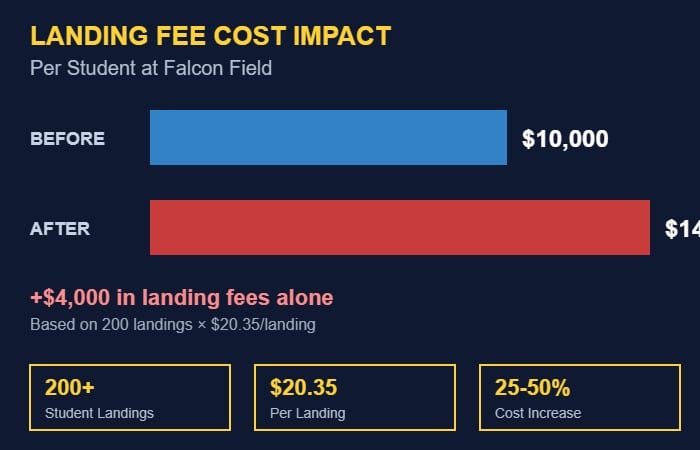
Consider a typical private pilot student at Falcon Field. The FAA requires a minimum of 40 flight hours for a private certificate. However, most students need 60 to 80 hours in practice. Additionally, a large portion of those hours involve pattern work, touch-and-goes, and dedicated landing practice.A conservative estimate puts total landings for a private pilot course at 200. At $20.35 per landing, that adds $4,070 to the cost of training. Currently, the private pilot certificate costs $8,000 to $15,000 at most schools. Therefore, an extra $4,000 represents a 25 to 50 percent increase in total flight training costs.
Moreover, instrument students need extensive approach practice. Commercial students need complex landing scenarios. CFI candidates need even more repetitions. Altogether, the cumulative cost increase across a full professional pilot program could exceed $10,000 at a single airport.
Flight Schools Face an Impossible Choice
Flight schools at Falcon Field now face a brutal dilemma. They can absorb the fees and watch their margins evaporate. Alternatively, they can pass the costs to students and risk losing enrollment. Neither option leads anywhere good.One Falcon Field flight school owner put it bluntly. He said the fees would force him to either close up shop or raise prices so much that closing becomes inevitable anyway. Similarly, another school estimated the fee would raise total training costs by roughly $4,000 per student.
Furthermore, Falcon Field is not a small operation by any measure. Training flights make up approximately 80 percent of the airport’s total traffic. In other words, the fee directly targets the airport’s largest user group. As a result, flight schools see this as a direct attack on their core business model.
The Pilot Shortage Gets Worse
The timing could not be worse for the aviation industry. The sector faces a well-documented pilot shortage that grows each year. Boeing’s 2024 Pilot and Technician Outlook projected a global need for 674,000 new pilots over the next 20 years. Consequently, every barrier to entry makes this shortage harder to solve.Higher flight training costs discourage prospective students from enrolling. Indeed, many aspiring pilots already struggle to finance their training. Adding thousands of dollars in airport landing fees pushes the dream further out of reach. As a result, fewer students start training and fewer finish.
For context, E3 Aviation Association has long championed making aviation more accessible to everyone. Landing fees that price out the next generation of pilots run directly counter to that mission. Instead, the industry needs creative solutions that lower barriers to entry.
This Is Not Just a Falcon Field Problem
Falcon Field grabbed the headlines in March 2026. However, it represents just one piece of a larger trend that should alarm every GA pilot and aircraft owner. In fact, multiple airports now impose or consider landing fees on general aviation operations across the country.
DeKalb Peachtree Joins the List
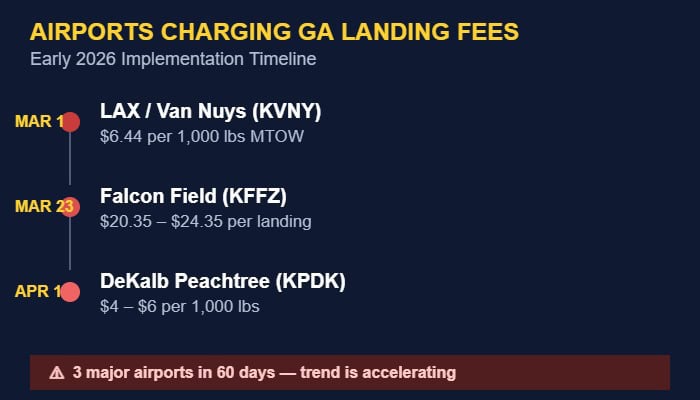
DeKalb Peachtree Airport near Atlanta launched its own landing fee program on April 1, 2026. Specifically, the fee structure charges transient aircraft based on maximum takeoff weight. Aircraft between 9,001 and 20,000 pounds pay $4 per thousand pounds. Meanwhile, heavier aircraft pay $6 per thousand pounds.Notably, PDK’s fees target larger transient aircraft rather than light trainers. Still, the precedent matters enormously. Once one airport proves that landing fees generate meaningful revenue, others follow quickly. In fact, the domino effect has already started across multiple states.
Los Angeles and Van Nuys Lead the Way
Los Angeles International Airport and Van Nuys Airport implemented GA landing fees on March 1, 2026. The rate stands at $6.44 per thousand pounds of maximum takeoff weight. Importantly, Van Nuys is one of the busiest GA airports in the world. Therefore, its fee structure sends a clear signal to other large GA airports nationwide.Currently, these West Coast fees primarily affect larger aircraft. But the framework now exists for expansion. Indeed, extending fees to lighter aircraft requires only a policy change, not new infrastructure. That possibility worries GA advocates and flight training costs watchdogs deeply.
A Nationwide Trend Takes Shape
Three major airports implemented GA landing fees within a 60-day window in early 2026. This is not coincidence or random timing. Airport managers across the country face similar budget pressures from deferred maintenance. Additionally, federal grant funding has not kept pace with infrastructure needs at many fields.Furthermore, many airports that once relied on fuel flowage fees or lease revenue now look at landing fees as a tempting new revenue stream. Municipalities increasingly view their airports as financial liabilities rather than community assets. When budget shortfalls appear, per-landing charges become an attractive quick fix. Unfortunately, pilots and flight schools rarely have the political clout to stop these measures before they pass.
The ADS-B Connection: Safety Technology as a Fee Collector
The Falcon Field story connects to another controversy rocking general aviation right now. Specifically, airports use ADS-B data to track and count landings for fee collection purposes. This repurposing of critical safety technology outrages pilots and aviation organizations nationwide.
How ADS-B Tracking Enables Fee Collection
ADS-B stands for Automatic Dependent Surveillance-Broadcast. It transmits an aircraft’s position, altitude, and identification in real time. The FAA mandated ADS-B Out equipment in most controlled airspace starting in 2020. Importantly, pilots installed this equipment for safety purposes only. They did not expect it to become a billing tool.However, airports discovered they could use ADS-B data to automatically count landings at their facilities. No manual tracking is required with this approach. No tower personnel need to record tail numbers either. Instead, the system counts every touchdown and generates invoices automatically. Several Arizona airports already use this exact method today.
For a deeper look at ADS-B data misuse, read Your ADS-B Data Is No Longer a Cash Register: What the ALERT Act Means for GA Pilots on the E3 Aviation blog.
Legislative Pushback Gains Real Momentum
Fortunately, pilots fight back through legislation at multiple levels. Arizona House Bill 2210 would prohibit government entities from using ADS-B data to calculate landing fees. At the federal level, the Pilot and Aircraft Privacy Act gains cosponsors steadily. Additionally, NTSB Chair Jennifer Homendy publicly stated that ADS-B should serve safety purposes only.Notably, Montana became the first state to ban ADS-B-based fee collection back in May 2025. Since then, more than a dozen other states consider similar bills. Meanwhile, the House Transportation and Infrastructure Committee passed the amended ALERT Act. This bill includes strong provisions against ADS-B misuse for revenue generation.
Furthermore, AOPA leads the charge nationally on this issue. The organization sends letters to airports implementing ADS-B-based fees. Their message stays consistent. Safety technology must remain a safety tool. It should never become a revenue generator that punishes general aviation pilot training operations.
How Airport Landing Fees Affect Every Aircraft Owner
Landing fees do not hurt only students and flight schools. In reality, they affect every pilot and aircraft owner who flies into a fee-charging airport. The financial and operational impacts ripple across the entire GA community in multiple ways.
Based Aircraft Owners Feel the Squeeze
Pilots who base their aircraft at Falcon Field already pay hangar rent, tie-down fees, and fuel costs. Now, landing fees add yet another layer of recurring expense. Even with 10 free landings per month, an active owner who flies three or four times per week exceeds that threshold quickly.As the team at E3 Aviation Association has noted, aircraft ownership costs keep climbing year after year. Insurance premiums rose sharply in recent years. Maintenance costs follow inflation steadily. Therefore, adding per-landing fees to this burden may push some owners to sell their aircraft or relocate entirely.
Additionally, these costs reduce how often owners fly. A pilot who hesitates before each flight because of fees flies less frequently. Less frequent flying means less proficiency. Less proficiency means higher accident risk. In this way, landing fees can actually harm aviation safety.
Itinerant Pilots Change Their Plans
Transient pilots will simply avoid fee-charging airports when possible. This behavior pattern is well documented at airports that charge ramp fees. Instead of stopping at a fee airport, pilots divert to nearby fields that welcome GA traffic without extra charges.For Falcon Field specifically, this means fewer itinerant aircraft buying fuel or patronizing restaurants. Consequently, the economic ripple effect extends well beyond the airport fence. Local businesses that depend on aviation traffic lose customers too. In many cases, the lost economic activity exceeds the revenue generated by the fees themselves.
Property Values and Community Impact
Ironically, some Mesa residents pushed for landing fees hoping to reduce airport traffic and noise. Fewer training flights would mean quieter neighborhoods, they argued. But airports exist under FAA grant assurances that come with federal funding. These assurances require airports to remain open to all aviation users on reasonable terms.Moreover, if landing fees drive away flight schools and reduce traffic significantly, Falcon Field’s revenue could actually decline. Fewer operations mean less fuel sold and fewer hangars rented. The airport could end up in worse financial shape than before the fees took effect. In other words, the cure might prove worse than the disease for Mesa’s budget.
What Pilots and Owners Can Do Right Now
The GA community is not powerless in this fight. In fact, pilots, aircraft owners, and aviation businesses have several effective tools at their disposal. Here are the most impactful actions you can take to fight back against unfair landing fees at their local airports.
Engage in Local Politics Immediately
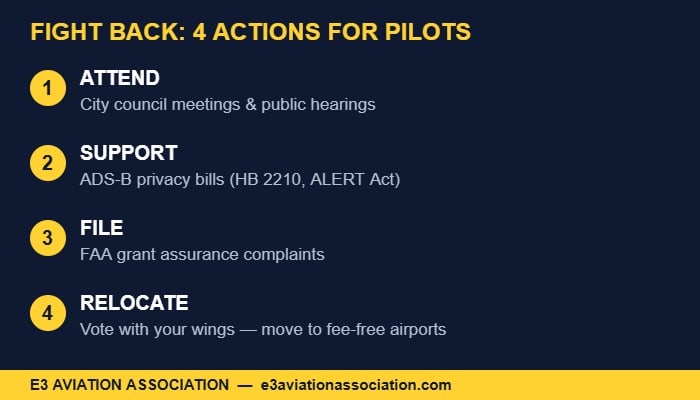
The Falcon Field vote passed because too few pilots showed up to oppose it. City councils respond to constituents who actually appear at meetings. Therefore, pilots who base at municipal airports should attend council meetings and speak during public comment periods. Building relationships with local officials before fee proposals appear makes a real difference.Additionally, pilots should join forces with airport tenants, FBOs, and flight schools. Together, they present a unified and powerful voice. Politicians pay attention to organized groups with data and passion. In contrast, a fragmented response gets ignored every time.
Support Legislative Efforts at Every Level
Contact your state and federal representatives about this issue today. Specifically, ask them to support bills that protect pilots from ADS-B-based fee collection. The Pilot and Aircraft Privacy Act needs more cosponsors in Congress. Similarly, state-level bills like Arizona HB 2210 need vocal public support to pass.AOPA’s advocacy team tracks these bills closely. They also provide easy tools for contacting legislators directly. Use them regularly. Indeed, every email, phone call, and letter makes a difference. Legislators need to hear from real pilots who live in their districts and vote in their elections.
File FAA Complaints When Warranted
Airports that accepted federal funding must comply with FAA grant assurances. Importantly, these assurances include provisions about reasonable and nondiscriminatory access for all users. If landing fees unfairly target specific user groups like flight training operations, pilots can file formal complaints with the FAA.The FAA investigates grant assurance violations seriously. A well-documented complaint backed by solid data carries real weight. Therefore, pilots should track their fees carefully and document the impact on their operations. Then they should submit formal complaints when the evidence supports a violation.
Vote with Your Wings
Sometimes the most effective protest is purely economic. Pilots who can relocate their aircraft to fee-free airports should seriously consider doing so. Likewise, flight schools that can move operations to more welcoming fields send a powerful message to fee-charging airports.When airports see revenue decline because pilots departed, they reconsider their fee structures rapidly. Economic pressure often works faster than political advocacy alone. Together, political engagement and economic action create the strongest response possible.
To learn more, join the E3 Aviation community at: https://e3aviationassociation.com/
The Bigger Picture: General Aviation’s Fight for Survival
Airport landing fees represent just one front in a broader battle for general aviation’s future. Simultaneously, flight training costs, insurance premiums, regulatory burdens, and infrastructure challenges all threaten the GA ecosystem from different angles.
Flight Training Costs Hit Record Highs in 2026
A private pilot certificate now costs between $8,000 and $15,000 at most U.S. flight schools. Meanwhile, a full professional pilot program from zero experience to airline-ready runs approximately $80,000 to $125,000. These numbers represent significant increases from just a decade ago.Every additional fee, tax, or surcharge compounds the affordability problem. Notably, landing fees prove particularly insidious because they scale with practice. The more a student practices landings—exactly what safe pilots should do—the more they pay. This creates a perverse incentive to reduce critical practice time during training.
For perspective, a student who avoids extra pattern work to save on fees graduates with less experience. That student enters the aviation system less prepared. The safety implications should concern everyone who flies.
The MOSAIC Rule Offers a Bright Spot
Not all news is grim for general aviation pilot training. The FAA’s MOSAIC rule, with Phase 2 taking effect July 24, 2026, promises to expand the Light Sport Aircraft category significantly. This expansion could lower the barrier to entry for many aspiring pilots. Specifically, more affordable aircraft, simpler medical requirements, and expanded privileges should help grow the pilot population.For a complete breakdown of what MOSAIC means for you, check out The MOSAIC Phase 2 Countdown: Everything GA Pilots Need to Know Before July 24, 2026 on the E3 Aviation blog.
However, MOSAIC’s benefits evaporate if landing fees make flying too expensive. New pilots attracted by affordable LSA aircraft still need affordable places to train and practice. In this way, these fees directly undermine the growth that MOSAIC aims to create for the GA community.
Airports Must Partner with GA, Not Punish It
Airports and general aviation genuinely need each other to thrive. Flight training operations fill pattern traffic, burn fuel, and generate steady revenue streams. Without GA activity, many smaller airports would struggle to justify their continued existence to local governments.Instead of imposing punitive fees, smart airport managers find creative ways to fund operations. For instance, fuel flowage fees, hangar lease revenue, and commercial development on airport property all offer viable alternatives. Similarly, non-aviation revenue from events and land leases can supplement budgets effectively. Per-landing fees that target training flights represent the laziest and most destructive approach available.
Ultimately, airports that embrace GA prosper over time. Airports that punish GA lose traffic, revenue, and community support. The choice should be obvious to any airport manager thinking beyond the next budget cycle.
Frequently Asked Questions About Airport Landing Fees
Question: What are the new airport landing fees at Falcon Field?
Answer:
Question: How do airport landing fees increase flight training costs?
Answer:
Question: Are other airports implementing similar landing fees for general aviation?
Answer:
Question: How does ADS-B data relate to landing fees at airports?
Answer:
Question: What can pilots do to fight unfair airport landing fees?
Answer:
Question: Will landing fees at airports worsen the pilot shortage?
Answer:
To discover more about building an aviation career, click: https://e3aviationassociation.com/e3-aviation-association-pilot-manifesto/
Written by the E3 Aviation Team, a group of experienced pilots, aviation writers, and industry professionals dedicated to promoting safety, education, and passion in general aviation.
For more aviation resources and insights, be sure to visit: https://e3aviationassociation.com/articles/
To discover more about E3 Aviation visit: https://e3aviationassociation.com/
Sources: