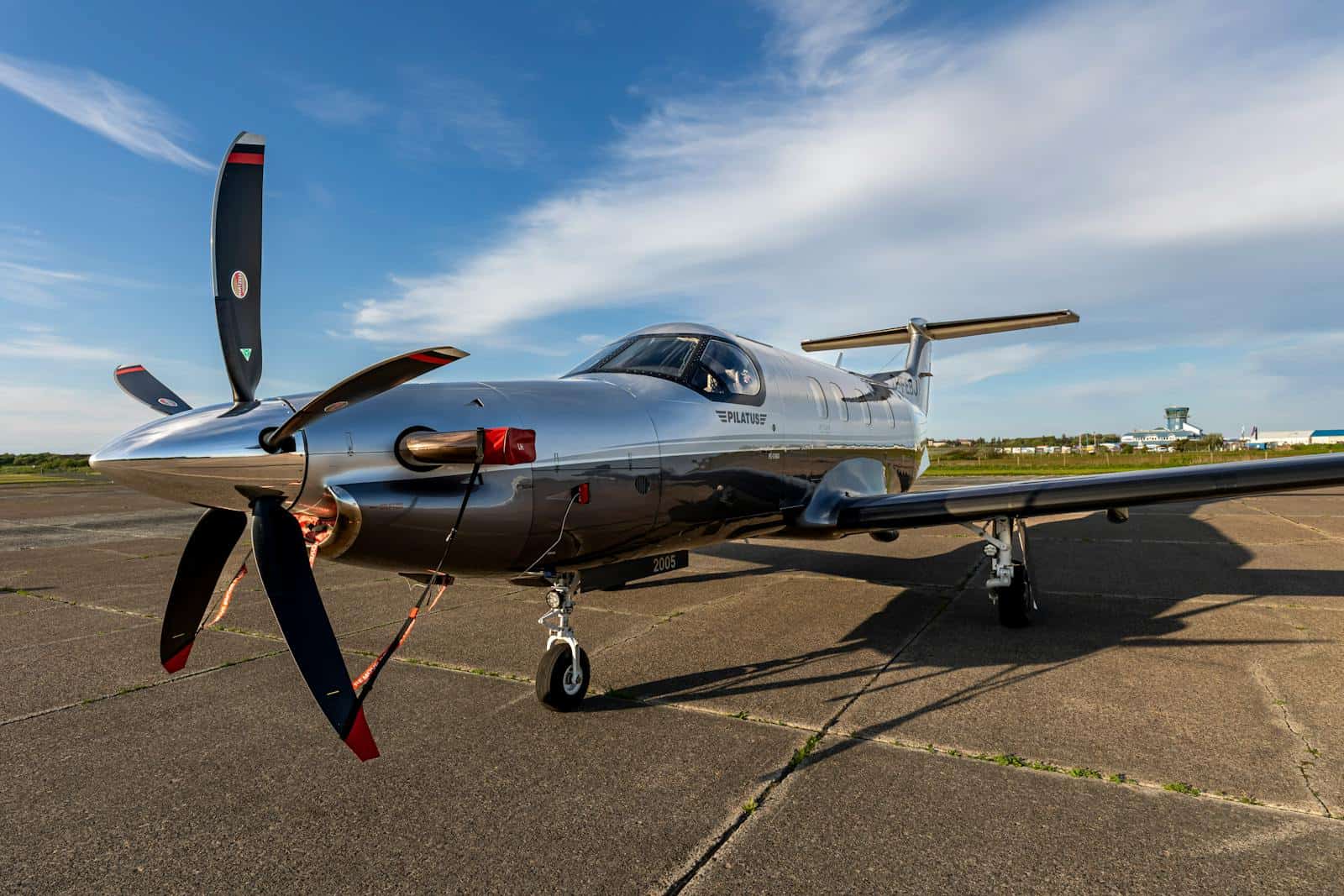
The Pilatus PC-12 business aircraft sits in an unusual market position. It’s a single-engine turboprop priced near light-jet territory, marketed primarily to owner-operators and small charter operations. The buyers who choose it are typically aware they could afford a jet — and they’re choosing the PC-12 anyway, because of what the airframe does and how it’s built.
This is a closer look at what the PC-12 actually delivers, why the Swiss craftsmanship reputation is more than marketing, and how the airframe fits the modern owner-operator mission profile. Pilatus has been refining this design since 1991, and the current PC-12 NGX is the most refined version of an airframe that already had a strong reputation.
The PC-12 Mission and Why It Persists
The PC-12 was designed around a specific mission: take six to eight passengers and cargo into small airports at jet-adjacent speeds, with the operating economics of a turboprop. It was never intended to compete head-on with light jets. Instead, it filled a gap that the jet market couldn’t address well — short-field performance, gravel-strip capability, and a cabin sized for real cargo, not just briefcases.
That mission has remained valuable. Despite jet manufacturers introducing entry-level single-pilot jets like the Cirrus Vision and Honda HA-420, the PC-12 retains a loyal owner base. The reason is operational flexibility — a jet can’t operate from a 2,500-foot grass strip, but a PC-12 can.
The PC-12 mission profile favors owners who fly into smaller airports, carry mixed passenger and cargo loads, or value the cabin’s flexibility — flat-floor configurations, large cargo door, ability to remove seats for hauling gear or equipment. Many PC-12 owners are entrepreneurs, ranch owners, regional medical operators, or families with second homes in places jets can’t reach.
What Makes the Swiss Craftsmanship Real
“Swiss craftsmanship” is often marketing language, but with Pilatus it describes a specific manufacturing philosophy. The Stans, Switzerland facility builds each PC-12 to order, with a level of vertical integration that’s rare in modern aircraft manufacturing. Major structural components, avionics integration, and interior finishing all happen under one roof, in a culture built around aerospace tolerances.
The visible signs of that culture show up in the cabin — panel fit, leather work, switchgear feel — but the more important signs are operational. Pilatus aircraft have a reputation for predictable maintenance, lower-than-expected unscheduled downtime, and long service lives. The first PC-12s built in the mid-1990s are still flying, many with high hours and high cycles.
Pilatus owns the entire supply chain in a way that’s increasingly unusual. They source raw materials, fabricate major components in-house, and control quality at every stage. That vertical integration is expensive — it shows up in the PC-12’s price — but it produces an airframe with a known long-term cost profile.
Performance: What the Numbers Actually Mean
The current PC-12 NGX cruises at roughly 290 knots true airspeed with a service ceiling of 30,000 feet. Range with full fuel is around 1,800 nautical miles. The Pratt & Whitney PT6E-67XP engine produces 1,200 shaft horsepower in the latest variant, with FADEC controls that simplify operation compared to earlier PT6 variants.
The takeoff and landing distances are what set the PC-12 apart from light jets. It can operate from runways under 2,500 feet at sea level, with ample weight. That capability opens hundreds of airports that a Citation or similar light jet cannot use. For owner-operators flying into recreational properties, regional medical clinics, or rural business locations, the airport access is the entire point.
Climb performance from sea level to flight levels is around 12–15 minutes to FL250, depending on weight and atmospheric conditions. The aircraft handles density altitude well, an important consideration for owners operating in the mountain West.
The Cabin: Why It’s Different
The PC-12 cabin design philosophy diverges from light jets. Where a Citation Mustang or Phenom 100 prioritizes maximum cruise speed and traditional executive layout, the PC-12 prioritizes cabin flexibility. The standard configuration is six executive seats, but the cabin can be reconfigured for nine seats, all-cargo, or mixed passenger-and-cargo with a large rear door.
The flat-floor design and aft cargo door make the PC-12 functionally similar to a small van inside. You can load skis, hunting gear, medical equipment, or actual freight without complex loading procedures. That cargo flexibility is what attracts ranch owners, medical operators, and outdoor enthusiasts who can’t justify two aircraft.
Cabin pressurization is robust — 5.75 PSI differential, providing roughly an 8,000-foot cabin at 26,000 feet. That matches or exceeds many light jets and makes long-leg passenger comfort genuinely competitive with turbojets.
Single-Pilot Operation and the Type Rating
The PC-12 is certified for single-pilot operation, which is a meaningful operational and economic factor. Many owner-operators fly their own aircraft, and the PC-12’s automation and predictable handling make that practical even at high altitudes. The PC-12 requires a type rating issued under FAR 61.31 because of its maximum gross weight, but the training pathway is well-established and most insurance carriers offer reasonable terms.
Insurance for owner-operators centers on total time, type-specific time, and recurrent training requirements. New PC-12 owners typically face mandatory annual recurrent training in a simulator (FlightSafety or SimCom are the primary providers), plus mentor-pilot requirements for the first 25–50 hours of type operation.
The cost of operating a PC-12 single-pilot makes the economic case compelling for the owner who flies their own mission. A two-pilot light jet has fundamentally different operating economics, and the PC-12’s single-pilot capability is part of why owner-operators choose it.
Operating Costs: The Real Numbers
Direct operating costs for the PC-12 typically run $700–$900 per flight hour, including fuel, scheduled maintenance reserves, and engine reserves. Fuel burn at typical cruise altitudes is around 70–80 gallons per hour of jet-A. The PT6 family has a well-known reputation for predictable maintenance costs, and Pilatus’s published cost-per-mile figures are validated by long-term operator data.
Fixed costs — hangar, insurance, annual inspection, recurrent training — add roughly $150,000–$250,000 per year for a typical owner-operator profile. Total annual ownership cost lands in the $400,000–$700,000 range, depending on hours flown and utilization.
Compared to a comparable light jet, the PC-12 typically costs 30–40% less per hour to operate. The savings come from lower fuel burn at slower cruise speeds, single-pilot operation, and turboprop maintenance economics versus turbojet.
The Pilatus Service Network: What Owners Actually Get
Pilatus operates one of the most respected service networks in business aviation. The Stans, Switzerland headquarters serves as global support, with major service centers in Broomfield, Colorado (United States), Adelaide (Australia), and Buochs (Switzerland). The Broomfield facility — featured in much of Pilatus’s brand material — handles a substantial portion of North American PC-12 service work.
The service philosophy emphasizes scheduled-maintenance predictability and rapid response to AOG situations. PC-12 owners report typical scheduled-maintenance turnaround times of 5–10 days, compared to 15–30 days for some competitor aircraft. The parts inventory at the major service centers is deep, which keeps unscheduled downtime low.
The cost is part of the value proposition. Pilatus owners pay for the service network in the aircraft’s acquisition price and operating cost, and the network delivers. Owners who have transitioned from other business aircraft brands almost universally describe the service experience as the most consistent surprise of PC-12 ownership.
Crew Training and Type Rating Pathway
The PC-12 requires a type rating because its maximum gross weight exceeds 12,500 pounds. The type rating pathway is well-established — FlightSafety International and SimCom both operate full-motion PC-12 simulators with comprehensive curricula. Initial type training typically takes 7–10 days of classroom and simulator work, followed by aircraft transition.
The PC-12 community has built a robust mentor-pilot network. Most new PC-12 owners fly 25–50 hours with a mentor before flying solo with passengers, and many insurance carriers require it explicitly. The mentor-pilot infrastructure means new owners get extensive in-aircraft experience with someone who knows the airframe well.
Recurrent training is annual for most owners — a one-week simulator session that refreshes systems knowledge, emergency procedures, and operational standards. Insurance carriers typically require this recurrent training as a condition of coverage, and most PC-12 owners describe it as among the highest-value training investments they make.
Recent Updates: The PC-12 NGX and What Changed
The current production PC-12 NGX, introduced in 2019, represents the most significant refresh of the airframe since the type was certified in 1994. The PT6E-67XP engine introduced FADEC controls to the PC-12 for the first time, simplifying pilot operation and improving fuel economy by approximately 4–5%.
The NGX cabin received updated interior options, with new lighting, climate control, and entertainment systems. The avionics centered on the Honeywell Apex flight deck, with advanced terrain warning, traffic awareness, and weather radar integration. The Inertial Reference Sensor (IRS) update improved low-speed handling and tightened ride quality in turbulence.
For owners considering used PC-12s, the model year matters. Pre-NGX aircraft (PC-12/45, PC-12/47, PC-12/47E) are progressively more capable and offer different cabin and avionics options. The NGX is the most refined variant; the earlier models offer lower acquisition cost with proven service histories.
The Owner-Pilot Mission Profile
PC-12 owners typically operate on a mission profile that justifies the airframe’s specific capabilities. The most common pattern: 200–350 flight hours per year, mixed between business travel, family transportation, and occasional cargo or recreational missions. The owner-pilot is usually the primary pilot, sometimes supplemented by a hired pilot for longer trips or instrument conditions outside the owner’s comfort zone.
The geographic distribution favors regions where the PC-12’s short-field capability matters operationally. Mountain west, Pacific Northwest, Alaska, and certain rural markets see disproportionate PC-12 adoption. The aircraft thrives in operations that combine short hops to small airports with occasional long-leg cross-countries.
For new PC-12 owners, the first 100 hours typically involve significant operational learning — the airframe’s capabilities take time to internalize, particularly the short-field performance and the high-altitude cruise behavior. Most owners describe the second year of ownership as when the airframe really starts to deliver value as they grow into the mission.
How PC-12 Owners Talk About the Experience
Long-term PC-12 owners — those past the 500-hour mark in type — describe the ownership experience in remarkably consistent terms. The phrase “transformation of how I think about travel” comes up across owner interviews. Trips that would have been impossible or impractical with previous aircraft become routine. The cabin flexibility encourages mission expansion beyond what owners originally planned.
The service network experience is the other consistent theme. PC-12 owners express satisfaction with Pilatus’s service operations at rates significantly higher than business aviation industry averages. The combination of predictable maintenance, fast turnaround on scheduled work, and responsive AOG support translates into actual flying days that other airframes lose to downtime.
The Decision Framework for Considering a PC-12
For pilots weighing whether a PC-12 makes sense, the decision turns on three factors: mission profile, utilization, and comfort with single-engine turbine economics. Mission profile is the first filter — owners whose typical trips combine short-field operations with mid-to-long-leg cross-countries are the natural fit. Owners whose missions are exclusively longer legs to major airports may find a light jet more appropriate.
Utilization affects the math significantly. The PC-12’s operating costs make economic sense above 200 flight hours per year. Below 150 hours, chartering or fractional ownership often delivers better economics. Above 400 hours, the airframe is approaching commercial utilization, where adding a hired pilot may make sense.
Comfort with single-engine turbine operations is the third factor. Most pilots transitioning from piston twins or other turboprops adapt quickly. Pilots transitioning from light jets sometimes find the single-engine consideration weighing on their decision-making, which is appropriate — the PC-12’s safety record is excellent, but it’s a different airframe philosophy than twin-engine operations.
Resale Value and Long-Term Ownership
The PC-12 has historically held value better than most business aircraft. Five-year-old PC-12s commonly retain 70–80% of their original price, depending on condition and equipment. The market for used PC-12s is deep, with international demand particularly strong in Australia, Africa, and emerging markets where the short-field capability is operationally critical.
The PT6E-67XP engine in the NGX has a TBO of 5,000 hours, which is excellent for the powerplant class. Engine overhaul costs run $400,000–$500,000 at TBO, but the long TBO interval and predictable maintenance keep per-hour engine reserves manageable.
Avionics upgrades are a typical mid-life decision. The original PC-12 panels can be retrofitted with modern Honeywell Apex avionics, though the cost is significant. Many owners choose to trade up rather than upgrade major systems on older airframes.
Frequently Asked Questions
How fast does the Pilatus PC-12 fly?
The current PC-12 NGX cruises at approximately 290 knots true airspeed, with a service ceiling of 30,000 feet. Range with full fuel is around 1,800 nautical miles, depending on payload and cruise altitude.
Can one pilot fly a Pilatus PC-12?
Yes. The PC-12 is certified for single-pilot operation under FAR 61.31. A type rating is required because of the maximum gross weight, but most owner-operators fly the aircraft single-pilot after initial training and recurrent simulator sessions.
How much does a Pilatus PC-12 cost to operate?
Direct operating costs run roughly $700–$900 per flight hour. Total annual ownership cost, including fixed costs, lands in the $400,000–$700,000 range depending on utilization. That’s typically 30–40% less than comparable light jets.
Why do owners choose a PC-12 over a light jet?
Short-field performance, cabin flexibility, single-pilot economics, and operating cost. The PC-12 can use 2,500-foot runways that no light jet can access, and the flat-floor cabin handles mixed passenger and cargo loads no jet cabin can match.
Related Reading
MOSAIC LSA Rule 2026
How the FAA’s new LSA rule reshapes the GA fleet.
Upgrading Your Aircraft Guide
When to upgrade systems versus trade up the entire airframe.
Aircraft Maintenance Innovations
Modern tools and methods that change ownership economics.
Last Updated: May 14, 2026