You remember the exact moment it clicked. Maybe it was watching a small Cessna climb away from a grass strip. Maybe it was a seat on a commercial flight where you pressed your face to the window and thought: I want to be up front. For a lot of pilots, the decision to start learning to fly didn’t feel like a decision at all. It felt like finally stopping a fight with yourself.
Last Updated: May 3, 2026 | By: The E3 Aviation Editorial Team
This post is for everyone at that edge — curious, excited, maybe a little scared. We’ll walk through what the first flight actually feels like, how to choose a flight school, what the training process looks like, and why so many pilots say learning to fly changed everything for them.
What “Learning to Fly” Actually Means
Learning to fly in the United States means working toward a Private Pilot Certificate under FAA regulations. That certificate lets you fly a single-engine aircraft during the day and night, carry passengers, and travel cross-country under visual flight rules.
To earn it, you need at least 40 hours of flight time — though the national average is closer to 60 to 70 hours. That time breaks down into dual instruction with a Certified Flight Instructor (CFI), and solo flight time that you log on your own. You also need ground school knowledge covering weather, airspace, navigation, aerodynamics, and aviation regulations.
Additionally, you must pass two tests: a written knowledge exam and a practical test (called a checkride) with an FAA Designated Pilot Examiner. The checkride has both an oral portion and a flight portion. Pass both, and you walk away with your certificate.
It sounds like a lot. But most students complete the private certificate in six to twelve months at a pace that fits around work and family.
Your First Flight: What to Expect
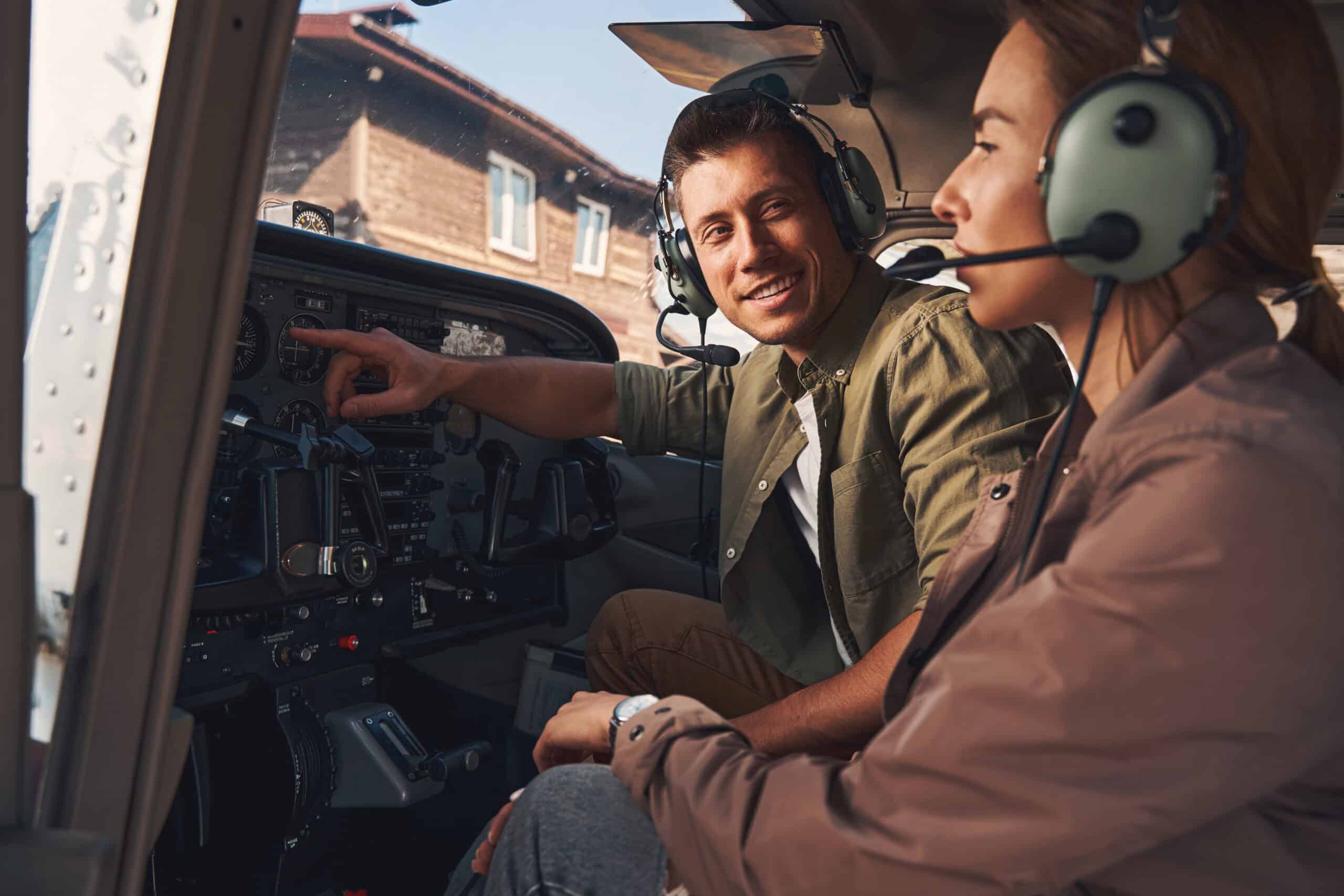
Most people start with what’s called a discovery flight — a short introductory lesson with a CFI where you actually get your hands on the controls. It usually runs 30 to 60 minutes and costs between $150 and $250, depending on the aircraft and location.
The Takeoff Will Catch You Off Guard
Nothing really prepares you for a takeoff in a small aircraft the first time. In a 172 or a Piper Cherokee, you feel every bump of the runway under you. Then the nose lifts. Then the ground just drops away. There’s no massive thrust like a jetliner — it’s smooth, almost quiet, and completely exhilarating.
Your CFI will walk you through the controls in the air. They’ll show you how small inputs on the yoke or stick change the aircraft’s attitude. You’ll bank left and right. You’ll climb and descend. You’ll probably grin like an idiot the whole time.
Honestly, this is one of our favorite things about aviation: the first flight doesn’t just teach you something — it rewires you. Pilots who’ve been flying for decades still talk about their first flight like it happened last week.
Your Body Needs a Few Flights to Catch Up to Your Brain
Motion sensitivity is real and it’s normal. Small aircraft move in three dimensions in ways your body has never experienced. The inner ear takes time to adapt. Many new students feel a little queasy on early flights — not because they’re not cut out for flying, but because they’re new to it.
This gets better fast. Most students find that by their third or fourth flight, the body has adapted and the motion feels natural. Flying on an empty or full stomach makes it worse. Fly on a light meal, stay hydrated, and keep your eyes on the horizon.
Choosing a Flight School That Won’t Waste Your Time
This is where a lot of new students make expensive mistakes. Not all flight schools are created equal, and the wrong choice can double your training time and cost.
The Real Questions to Ask Before You Sign Anything
First, ask about aircraft availability. A school with two Cessna 172s and 40 students will have you waiting weeks between lessons. Consistency matters in flight training — gaps in lessons mean you re-learn things you already covered. Look for a school with enough aircraft to keep you flying at least twice a week.
Second, ask about CFI turnover. Part 61 schools often rely on young instructors building hours toward an airline job. There’s nothing wrong with that — many are excellent teachers. But if your CFI leaves mid-training, you lose continuity. Ask how long the average CFI has been at the school.
Third, ask what syllabus they use. Structured training programs produce better, faster results than ad-hoc lesson planning. A good school uses a recognized curriculum and tracks your progress lesson by lesson.
We’ll be straight with you: the cheapest flight school in town is often not the best value. A school that charges slightly more but flies consistently and keeps you on track will cost less in the long run than a cheap school where you repeat lessons due to scheduling gaps and inconsistent instruction.
The Training Syllabus: What You Learn and When

Flight training follows a predictable progression. Understanding where you’re headed makes the process feel less overwhelming.
In the first phase, you learn basic aircraft control — straight and level flight, climbs, descents, and turns. You also learn the traffic pattern, which is the rectangular flight path around an airport used for takeoffs and landings. Landings are the hardest skill in private pilot training and the one that takes the most repetition.
Solo flight is a major milestone. Your CFI will sign you off to fly the aircraft alone — typically after 15 to 20 hours of dual instruction. That first solo is one of the most memorable moments in any pilot’s life. The aircraft feels different without someone in the right seat. It’s just you and the airplane. Many pilots describe it as the moment they knew they were really doing this.
After solo, training shifts to cross-country navigation. You plan routes, calculate fuel loads, brief weather, and fly from one airport to another using VOR navigation, GPS, and pilotage. These flights build confidence and competence simultaneously.
Finally, you practice emergency procedures — engine failures, instrument malfunctions, off-airport landing options. The FAA wants to know you can handle the unexpected, and the training makes sure you can.
The first significant milestone is the solo flight. Before your CFI endorses you for solo, you need to demonstrate consistent takeoffs, landings, and the ability to handle basic emergencies. Most students solo between 15 and 30 hours. First, you master straight-and-level flight, turns, climbs, and descents. Then, you move into the traffic pattern — the rectangular flight path around the runway used for takeoffs and landings. Finally, your instructor gets out of the plane, and you fly three laps around the pattern alone. That first solo is something pilots never forget.
After solo, the focus shifts to cross-country flying. The FAA requires at least one solo cross-country of 150 nautical miles with landings at two other airports. This phase teaches navigation, weather decision-making, and flying in unfamiliar airspace. Additionally, you complete night flight training, instrument flight time under the hood, and simulated emergency procedures. The last phase is checkride preparation — polishing maneuvers, reviewing regulations, and building consistency under pressure.
Ground School: Don’t Skip It
Every hour you invest in ground school makes your flight training faster and cheaper. Pilots who understand the theory behind what they’re doing learn maneuvers more quickly than pilots who are just following instructions.
Ground school covers weather theory and how to interpret aviation weather products, airspace structure and how to navigate the different classes, aerodynamics and how the four forces of flight work, aviation regulations and the FARs that govern private pilots, and navigation using charts, GPS, and radio navigation aids.
You can take ground school in person at your flight school, through an online course, or through self-study using an approved textbook. Many students use a combination of all three. The written knowledge test has 60 multiple-choice questions, and you need a 70% to pass. Most students who study consistently score well above that.
The Medical Certificate — Getting It Out of the Way Early
Before you fly solo, you need a valid medical certificate. For private pilot operations, a third-class medical is the minimum. It’s obtained from an FAA Aviation Medical Examiner (AME) — a physician designated to perform aviation medicals.
The exam covers vision, blood pressure, heart health, and general physical condition. Most healthy adults pass without difficulty. However, if you have a pre-existing medical condition, it’s worth researching before you start training. Some conditions require a Special Issuance, which takes longer but is often approvable.
One exception: BasicMed. Private pilots who hold or have held a medical certificate can fly under BasicMed instead of maintaining a third-class medical. It requires a regular visit with your personal physician and an online course. If this applies to you, talk to your CFI about whether BasicMed works for your training situation.
The medical exam takes about 30 minutes. Your Aviation Medical Examiner (AME) will check vision, hearing, blood pressure, and basic health. Most healthy adults pass the third-class medical without issue. If you have any existing health conditions, research the FAA’s BasicMed program — it offers an alternative path that allows many pilots with common conditions to fly with a regular doctor’s sign-off instead of an AME exam.
What Flying Gives You That Nothing Else Can
There are practical reasons to learn to fly. You can reach destinations faster. You can access airports that airlines don’t serve. Business travel becomes more flexible. Fly-in camping opens up parts of the country most people never see.
But the pilots who stick with it long-term — who keep flying after the certificate, who build hours, who take on new ratings — they’ll tell you the practical reasons weren’t really why they stayed.
Flying demands your full attention in a way almost nothing else does. When you’re in the pattern on a gusty afternoon, working the rudder and managing your energy, there’s no mental bandwidth left for work stress or family worries or whatever was bothering you on the drive to the airport. The cockpit is the most present place most pilots know.
Moreover, the pilot community is unlike any other. Airports are places where people help each other without being asked. Pilots share knowledge freely. The camaraderie at a small GA airport on a Saturday morning is something you have to experience to understand.
Our take: the certificate is the starting line, not the finish line. Once you’re flying, you’ll start thinking about instrument training, mountain flying, tailwheel endorsements, or backcountry strips. The more you fly, the more there is to explore.
The Cost — Let’s Be Honest About It
Flight training is not cheap. A private pilot certificate in 2024 will typically cost between $8,000 and $15,000, depending on your location, aircraft type, and how consistently you fly. Flying more often per week reduces the total cost by shortening the training timeline and reducing re-learning between lessons.
Some ways students manage the cost: scholarships from major pilot associations are available for student pilots — a quick search for “pilot training scholarships” will turn up several organizations that fund flight training, often based on merit or demographic criteria. Joining a flying club gives access to aircraft at rates well below solo rentals. And some employers with flight departments have tuition assistance programs for employees pursuing certificates.
Financing options exist too. Aviation lenders offer flight training loans, and some flight schools have in-house payment plans. The key is not letting cost uncertainty stop you from making a discovery flight. That first hour costs very little relative to the decision it helps you make.
In 2025, expect to budget