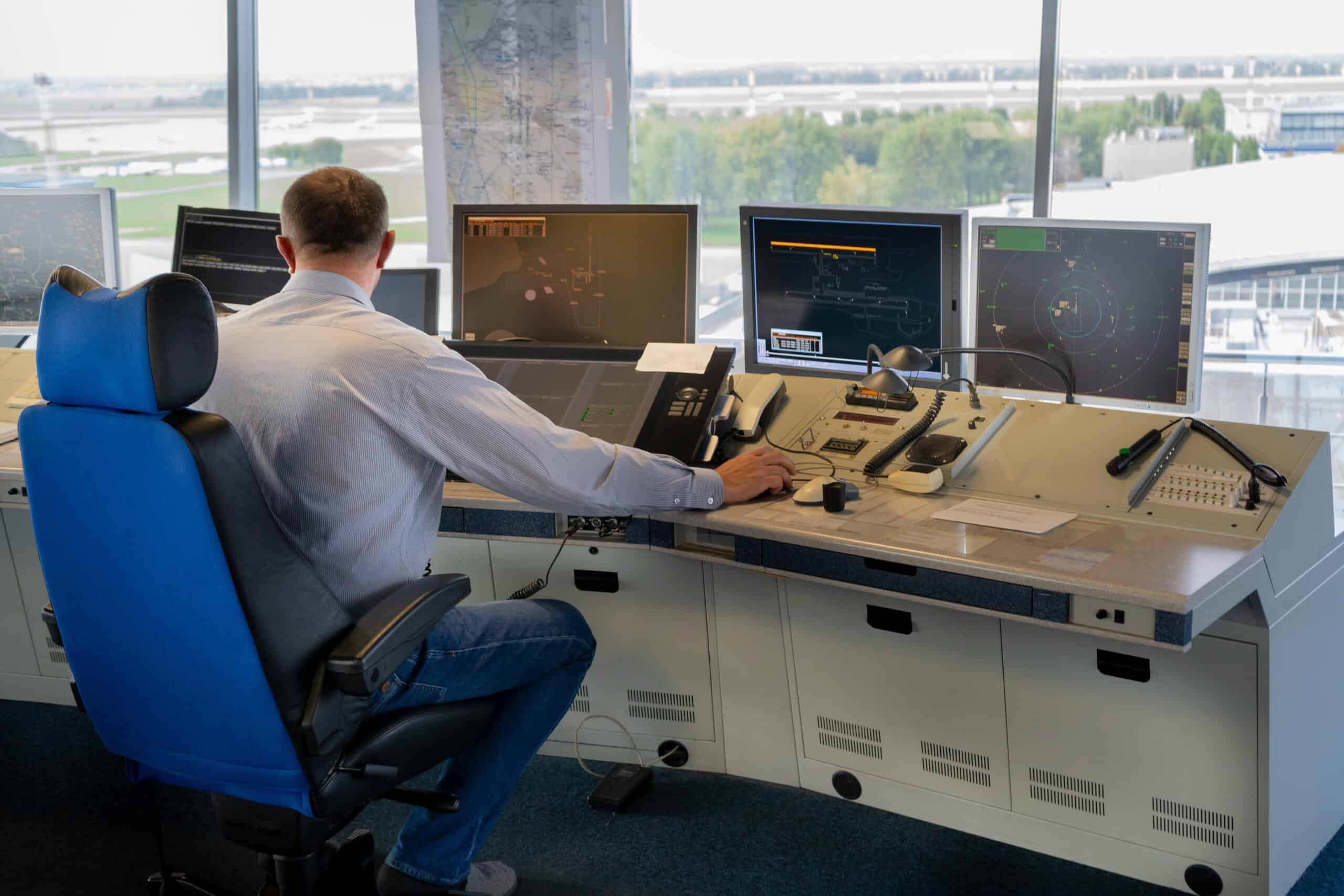
Air traffic control operations are the backbone of U.S. airspace management. Every day, FAA controllers handle more than 45,000 flights across the National Airspace System — coordinating departures and arrivals at major airports, managing traffic flow through the en route environment, and providing services to the general aviation aircraft that make up the vast majority of operations in the system.
Last Updated: May 7, 2026 | By: The E3 Aviation Editorial Team
Most GA pilots interact with ATC regularly but understand its internal structure only vaguely. They know there’s a tower and there’s Center and sometimes there’s Approach. They know to say their callsign, altitude, and request. But understanding how air traffic control operations are structured — who does what, how facilities hand off traffic, and how controllers make decisions — makes you a more effective communicator and a more confident pilot in the system.
The Structure of Air Traffic Control Operations in the U.S.
U.S. air traffic control operations are organized into four primary facility types: Air Traffic Control Towers (ATCTs), Terminal Radar Approach Control facilities (TRACONs), Air Route Traffic Control Centers (ARTCCs), and the Air Traffic Control System Command Center (ATCSCC). Each handles a specific phase of flight or a specific function within the overall system.
Air Traffic Control Towers — the facilities GA pilots interact with most visibly — handle airport traffic: departures, arrivals, and ground movements within the airport’s surface area. ATCT controllers work in sequence: ground control manages aircraft on the ramp and taxiways, local control (the tower cab position) manages aircraft on the active runways and in the airport traffic area, and in some facilities a clearance delivery position manages IFR clearance issuance before taxi.
Not all towers are equal. Contract towers, operated by private companies under FAA oversight through the Federal Contract Tower program, handle a significant portion of GA airports nationwide. FAA-operated towers handle the higher-activity facilities. The services provided are similar, but the staffing structures and oversight differ.

TRACON: The Approach Control Facility Most Pilots Don’t Think About
Terminal Radar Approach Control facilities — TRACONs — manage traffic in the terminal environment, typically from the surface to 10,000–14,000 feet MSL within 30–50 nautical miles of the primary airport. When you’re departing a towered airport and the tower hands you off to Departure, or arriving and Approach is vectoring you for the ILS, you’re talking to TRACON controllers.
TRACONs are radar facilities. Controllers watch your transponder return (and your ADS-B data) on scope and issue vectors, altitude assignments, and sequencing instructions to manage the flow of traffic in their sector. In busy terminal areas, TRACON controllers may be working 15–25 aircraft simultaneously across multiple frequencies.
Some major TRACONs — like Southern California TRACON (SoCal) and Northern California TRACON (NorCal) — serve enormous geographic areas encompassing multiple Class B airports. The consolidation of terminal services into mega-TRACONs has improved efficiency but also means that a pilot flying near LAX, SNA, SAN, and ONT may be talking to the same facility throughout a large portion of their flight.
ARTCC: En Route Air Traffic Control Operations Across the Country

Air Route Traffic Control Centers — what pilots call Center — handle en route traffic in the cruise phase of flight. The FAA operates 22 ARTCCs that collectively cover the contiguous U.S., Alaska, and Hawaii. Each ARTCC is divided into sectors, and each sector is staffed by a team of controllers working radar positions that cover a specific block of airspace defined by lateral and vertical boundaries.
When a TRACON hands you off to Center, you’re transitioning from the terminal environment to the en route environment. Center controllers manage the big picture: keeping aircraft separated by required minima, coordinating with adjacent Centers as traffic crosses sector and facility boundaries, and managing the flow of traffic through constrained airspace like weather deviations, military operations areas, and high-density routes.
GA pilots conducting VFR cross-country flights aren’t required to talk to Center in most situations — Class A airspace is the only airspace where IFR flight and two-way radio communication with ATC is mandatory in the en route environment. But requesting VFR flight following from Center is worth doing. Controllers provide traffic advisories and can coordinate with TRACON facilities during transitions. It costs you nothing and adds a layer of awareness to any cross-country flight.
How Controllers Manage the System: Tools and Decision-Making
Modern air traffic control operations depend on a combination of radar data, flight plan information, automation tools, and controller judgment. Primary radar shows aircraft returns without transponder data. Secondary radar — which requires a responding transponder — provides altitude, callsign, and ground speed. ADS-B data increasingly supplements radar with higher-precision position information and is particularly valuable for aircraft in areas of primary radar coverage gaps.
Traffic Flow Management tools help controllers and supervisors anticipate demand and manage congestion. When weather or capacity constraints are developing, the ATCSCC at Warrenton, Virginia coordinates Ground Delay Programs (GDPs), Ground Stops, and Airspace Flow Programs that hold aircraft on the ground or in defined holding areas rather than allowing them to saturate en route airspace or overwhelmed terminal environments.
For GA pilots, these system management programs can directly affect your flight even when the local weather is clear. A Ground Stop at your destination airport means no departures from the entire system are being released for that airport. A Miles-in-Trail restriction on a route means controllers are spacing IFR aircraft by distance rather than time, which can result in longer delays or reroutes. Understanding these concepts helps you understand ATC decisions that might otherwise seem arbitrary.
Communicating Effectively With ATC
Our take: most communication problems between GA pilots and ATC come from pilots who either say too much or not enough. The format that works in every situation is: who you’re calling, who you are, where you are, what you want. Controllers are working multiple aircraft simultaneously. A clear, structured initial call gives them the information they need to respond effectively.
Read-backs matter. When ATC issues an altitude assignment, a frequency change, or a runway assignment, read it back completely. Controllers use your read-back to confirm that you received the instruction correctly. A missed read-back is a missed safety check. If you’re uncertain whether you heard an instruction correctly, ask for a repeat: ‘Say again, [your callsign].’
Additionally, don’t be afraid to tell ATC when you can’t comply. If a controller assigns an altitude that you can’t reach due to aircraft performance or icing, say so. If a vector takes you toward terrain or clouds, say so. ATC is there to help you complete your flight safely, not to create obstacles. Controllers can and do accommodate pilot requests and limitations when they’re communicated clearly.
How ATC Workload Affects Pilot Safety
Controllers manage workload through sector splits, traffic flow restrictions, and miles-in-trail requirements — but pilots rarely see this behind-the-scenes coordination. What they do see is its effect: holding patterns, vectors, speed assignments, and altitude changes that may seem arbitrary from the cockpit but represent careful sequencing decisions.
Understanding this context makes pilots better communicators. A controller issuing a descent clearance later than expected isn’t being careless — they’re probably sequencing traffic you can’t see on your GPS. Readbacks that are crisp and complete, position reports that are accurate, and requests stated clearly and early all reduce controller workload. That creates more bandwidth for the controller to give you what you actually need.
The FAA’s Air Traffic Organization handles over 45,000 flights daily. Even small reductions in pilot-controller friction multiply across that volume into meaningful safety gains. Every pilot who communicates professionally contributes to a system that works better for everyone in the airspace.
Frequently Asked Questions About Air Traffic Control Operations
What is the difference between Approach and Center in ATC?
Approach control (TRACON) manages traffic in the terminal environment — typically within 30–50 nautical miles of an airport and below 10,000–14,000 feet MSL. Center (ARTCC) manages en route traffic in the cruise phase of flight across large geographic regions. When you depart a towered airport and are handed from Departure to Center, you’re transitioning from TRACON to ARTCC.
Do VFR pilots have to talk to ATC?
VFR pilots must communicate with ATC when operating in Class B, C, and D airspace, and when operating in Class A airspace (which requires IFR). Outside those airspace classes, VFR communication with ATC is optional but recommended — especially for cross-country flights where VFR flight following provides traffic advisories and coordination services.
What is a Ground Delay Program and how does it affect GA flights?
A Ground Delay Program (GDP) is a traffic management initiative that holds aircraft on the ground rather than allowing them to depart and saturate the destination airport’s arrival capacity. GDPs typically apply to IFR traffic. VFR GA flights may not be subject to a GDP directly, but the associated congestion, weather, and ATC workload can still affect your ability to receive services and complete your flight.
Sources
- FAA Air Traffic Organization — Operations and Services
- AVweb — ATC and Airspace
- General Aviation News
Advanced ATC Communication Techniques for Experienced GA Pilots
Standard phraseology gets you through most ATC interactions. Advanced technique separates pilots who merely comply from pilots who communicate with precision and situational intelligence. The difference shows up in busy terminal environments, unusual clearances, and situations where the standard script breaks down.
Readback Discipline: The Checksum of ATC Communication
Readback is not a formality. It’s the verification step that catches miscommunication before it becomes a violation or a conflict. FAA Order 7110.65 requires controllers to verify readbacks for runway crossings, altitude assignments, and altimeter settings. Pilots should provide correct, complete readbacks for every altitude, heading, and clearance assignment. Specifically, the readback must include your callsign — a readback without an identification doesn’t confirm which aircraft received the instruction. Controllers working multiple aircraft on the same frequency depend on callsigns to verify that the correct aircraft is complying.
When you don’t understand a clearance, say so immediately: “[Callsign], say again” or “[Callsign], unable, say again.” Controllers would rather say something twice than have an aircraft fly into a conflict because the pilot guessed at what was said. Additionally, if you receive a clearance that seems operationally impossible — a descent below terrain, an impossible intercept angle — query it. Controllers make mistakes. Safety pilots are not penalized for professional, respectful questioning of unusual clearances.
Handling Frequency Changes Smoothly
Frequency changes happen constantly in terminal environments. The standard handoff is: “Contact [facility] on [frequency].” Pilot response: “[Callsign], [frequency], good day.” Simple. However, pilots often make frequency changes too slowly — staying on a departing frequency too long, missing initial calls on the new frequency, or calling in with incorrect callsign or position on the new sector. Build the habit of monitoring both frequencies briefly during the transition by noting the new frequency before switching so you can identify yourself correctly on the first call.
Dealing with Workload Spikes in ATC Communication
Busy terminal environments stack multiple ATC interactions simultaneously: ATIS update, clearance delivery, ground taxi instructions, tower clearance, departure frequency handoff, and approach control check-in can all happen within 15 minutes of flight. Consequently, pilots who haven’t practiced high-tempo ATC communication in simulation or under instruction can find it cognitively overwhelming. The countermeasure: brief your expected ATC sequence before departure. Know which facilities you’ll contact, in what order, and approximately what to expect from each. When the sequence unfolds as expected, cognitive load stays manageable.
Transponder Operations and ATC Radar
Your transponder is ATC’s primary tool for tracking you. Operating correctly on transponder is essential in radar-covered airspace. Squawk 1200 is the VFR code — always squawk 1200 when VFR and not assigned a discrete code. When ATC assigns a discrete squitter code, enter it exactly as given and verify it with readback. Additionally, squawk 7700 (emergency), 7600 (radio failure), and 7500 (hijacking) are reserved codes with specific meanings — never squawk these codes inadvertently and never use them as test codes on the ground without coordinating with ATC first.
Mode C altitude encoding should match your altimeter within 300 feet of actual altitude. If your transponder consistently reports significantly different from your altimeter, a transponder test may be needed. ATC sees your transponder altitude independently of what you report verbally — discrepancies are visible to controllers and can trigger safety alerts.
When ATC Makes a Mistake: How to Handle Controller Errors
Controllers make mistakes. They issue wrong frequency assignments, give clearances to the wrong aircraft, and occasionally miss traffic conflicts. As PIC, your responsibility for flight safety doesn’t transfer to ATC — you retain it regardless of what ATC says. When a clearance seems operationally incorrect or unsafe, the correct response is professional, respectful pushback.
Specifically: if ATC clears you into terrain, weather, or traffic, decline the clearance: “[Callsign], unable that clearance, terrain [or traffic or weather].” If ATC gives you a descent that would take you below your MEA on an IFR flight, query it: “[Callsign], verify descent to [altitude], MEA on this segment is [altitude].” Controllers respond well to professional safety queries because they know their mistakes can have consequences. What they respond poorly to is silence followed by an accident. Speak up. That’s what the radio is for.
E3 Aviation Editorial Team
The E3 Aviation Association editorial team is made up of licensed pilots, aviation educators, and industry professionals dedicated to advancing general aviation safety, community, and education. Learn more about E3 Aviation.